Pokazywanie postów oznaczonych etykietą Porsche. Pokaż wszystkie posty

Porsche 911 Targa 1973

Wednesday 5 May 2021

The original Porsche 911 (pronounced nine eleven, German: Neunelfer) is a luxury sports car made by Porsche AG of Stuttgart, Germany. A prototype of the famous, distinctive, and durable design was shown to the public in autumn 1963. Production began in September 1964 and continued through 1989. It was succeeded by a modified version, internally referred to as Porsche 964 but still sold as Porsche 911, as are current models.

Mechanically, the 911 was notable for being rear engined and air-cooled. From its inception, the 911 was modified both by private teams and the factory itself for racing, rallying and other types of automotive competition. The original 911 series is often cited as the most successful competition car ever, especially when its variations are included, mainly the powerful 911-derived 935 which won 24 Hours of Le Mans and other major sports cars races outright against prototypes.

The Porsche 911 was developed as a much more powerful, larger, more comfortable replacement for the Porsche 356. The new car made its public debut at the 1963 Internationale Automobil-Ausstellung, better known to English speakers as the Frankfurt Motor Show.

It was initially designated as the "Porsche 901", after its internal project number. However, Peugeot protested on the grounds that in France it had exclusive rights to car names formed by three numbers with a zero in the middle. So, instead of selling the new model with another name in France, Porsche changed the name to 911. It went on sale in 1964.

The 1972–1973 model years consisted of the same models of 911— the entry level T, the midrange E and the top of the line S. However, all models got a new, larger 2,341 cc (2.341 L; 142.9 cu in) engine. This is universally known as the "2.4L" engine, despite its displacement being closer to 2.3 litres— perhaps to emphasize the increase over the 2.2 L. The new power ratings for the T were 130 hp (97 kW), or 140 hp (104 kW) in the U.S., 165 hp (123 kW) for the E and 190 hp (142 kW) for the S.

The 911E and 911S used mechanical fuel injection (MFI) in all markets. The 911T was carbureted, except in the United States where it also used MFI, which accounts for the 7 kW (9 hp) power difference between the two. In January 1973, U.S. 911Ts were transferred to the new K-Jetronic CIS (Continuous Fuel Injection) system from Bosch. These CIS-powered cars are usually referred to as "1973.5" models by enthusiasts.

With the power and torque increases, the 2.4 L cars also got a newer, stronger transmission, identified by its Porsche type number 915. Derived from the transmission in the Porsche 908 race car, the 915 did away with the 901/911 transmission's "dog-leg" style first gear arrangement, opting for a traditional H pattern with first gear up to the left, second gear underneath first, etc. Some say this was because the dog-leg shift to second gear was inconvenient for city driving, other say it was due to Porsche's desire to put 5th gear outside the main transmission housing where it could easily be changed for different races. The Sportomatic transmission was still available but only as a special order.

In 1972 a tremendous effort was made to improve the handling of the 911. Due to the 911's unusual engine placement (rear-mounted, with most of the vehicle's weight concentrated over the rear axle), early 911's were prone to oversteer when driven at the limit, and could easily spin in the hands of an inexperienced driver. In an attempt to remedy this, Porsche relocated the oil tank from its position behind the right rear wheel to in front of it. This had the effect of moving the weight of almost 8.5 L (9 US quarts) of oil from outside the wheelbase to inside, improving weight distribution and thus, handling. To facilitate filling of the oil tank, Porsche installed an oil filler door (much like the fuel filler door on the left front fender) on the right rear quarter panel. Unfortunately, this unique design was scrapped after only one year, some say because inattentive gas station attendants were putting gas in the oil tank. The oil tank was subsequently relocated to its original position for model year 1973, and remained there until it was relocated within the wheelbase for the 964 models.

911S models also gained a discreet spoiler under the front bumper to improve high-speed stability. With a weight of only 1,050 kg (2,310 lb), these models are often regarded as the best classic mainstream 911s. For racing at this time, the 911 ST was produced in limited numbers (the production run for the ST only lasted from 1970 to 1971.) The cars were available with a choice of either 2,466 cc or 2,492 cc engines, producing 270 PS (266 hp; 199 kW) at 8,000 rpm. Weight was down to 960 kg (2,120 lb). The cars had success at the Daytona 6 Hours, the Sebring 12 Hours, the 1000 km Nürburgring and the Targa Florio. 


Technical data:
- engine: F4
- capacity: 2466 cc
- horsepower: 266 HP
- gearbox: 4+1
- top speed: 230 km/h

Porsche 964 RS 3.8

Wednesday 11 December 2019
That is another, a bit cooler version of the vehicle described below.


Technical data:
- engine: Flat 6
- capacity: 3746 cc
- horsepower: 300 HP
- gearbox: 5+1
- top speed: 270 km/h

Porsche 964 Carrera 4

Wednesday 11 December 2019
The 911 SC came along in 1978, as the 911S and 911 Carrera disappeared. The 911 SC was available for all markets. It held a 3.0 liter engine, producing 180 horsepower. It remained pretty much the same over its lifespan, with different options taken and added here and there. In 1980, a special edition 911 Weissach came out to boost sales. However, the 1983 911SC carried the biggest change in the 911's history, it became convertible! It was called the 911SC Cabriolet, and was the first convertible Porsche since the 356. This became an extremely popular car, and was heralded as the fastest convertible in the world. They were sold out more than a year in advance. The Cabrio led Porsche into 1984, where the 911 Carrera took over.

These 911s are some of the best ever produced. They consistently are complemented on how well they're built and drive. By 1984, the 911SC was gone, and the Cabriolet had been introduced one year earlier. The Carrera now carried a 3.2 Liter engine, producing 202 hp. This car was the first to have DME fuel and ignition. The brakes were upgraded with a bigger booster and larger rotors. The heating system was upgraded, too, with two extra blowers. An option for 1984 included the Turbo look body, which included turbo metal, brakes, and wheels. In 1985, this option could be used on Coupes, Targas, or Cabriolets, and with or without the whale tail or front poilers. So pretty much any combination could be had in 1985. Occasionally, Porsche would make a 911 Slant-Nose, which looked like the racing 935. These were made up through the late 80's. Porsche also changed the oil cooler in 1985 to a finned, radiator type cooler. To provide the extra air needed, the opening in the bumper was enlarged.

In 1986, not much changed, the Cabriolet offered an electric top. Boge double tube, low pressure gas shocks were standard equipment. The sway bars and rear torsion bars were increased in size. A completely new transmission was applied in 1987, type G 50. The clutch was enlarged to cope with the larger engine. Hydraulic master and slave cylinders now activated the clutch. Power was at 217 horses. 1988 didn't bring much change either. A support brace was added between the transmission and the left heat exchanger to reduce the noise of the G 50 transmission. Also in 1988, a special edition 911 Carrera Clubsport was offered, as well as a limited number of Anniversary Carreras. 1989 brought about the last year for the classic 911, as the Carrera 4 was already out, and an all new 911 Carrera 2 was being readied for 1990.


Technical data:
- engine: Flat 6
- capacity: 3746 cc
- horsepower: 300 HP
- gearbox: 5+1
- top speed: 270 km/h

Porsche 959

Tuesday 9 January 2018
The Porsche 959 is a sports car manufactured by Porsche from 1986 to 1993, first as a Group B rally car and later as a legal production car designed to satisfy FIA homologation regulations requiring at least 200 street legal units be built.
When it was introduced, the twin-turbocharged 959 was the world's fastest street-legal production car, boasting a top speed of 195 miles per hour (314 km/h), with the sport model capable of reaching 197 miles per hour (317 km/h). During its production run it was hailed as the most technologically advanced road-going sports car ever built, and forerunner of all future super cars. It was one of the first high-performance vehicles with all-wheel drive, providing the basis for Porsche's first all-wheel drive Carrera 4 model. Its performance convinced Porsche executives to make all-wheel drive standard on all 911 Turbos starting with the 993. In 2004, Sports Car International named the 959 number one on its list of Top Sports Cars of the 1980s.
Development of the 959 (originally called the Gruppe B) started in 1981, shortly after the company's then-new Managing Director, Peter Schutz, took his office. Porsche's head engineer at the time, Helmuth Bott, approached Schutz with some ideas about the Porsche 911, or more aptly, a new one. Bott knew that the company needed a sports car that they could continue to rely on for years to come and that could be developed as time went on. Curious as to how much they could do with the rear-engined 911, Bott convinced Schutz that development tests should take place, and even proposed researching a new all wheel drive system. Schutz agreed, and gave the project the green light. Bott also knew through experience that a racing program usually helped to accelerate the development of new models. Seeing Group B rally racing as the perfect arena to test the new mule and its all wheel drive system, Bott again went to Schutz and got the go ahead to develop a car, based on his development mule, for competition in Group B.
Porsche developed an existing engine instead of creating a new one from scratch. The powerplant, a twin-turbocharged six-cylinder boxer engine with air-cooled cylinders and water-cooled heads, displaced 2.85 litres, about half a litre less than a contemporary 911 engine. It was coupled to a unique manual gearbox offering five forward speeds plus a "G" off-road gear, as well as reverse. The engine had originally been developed for the "Moby Dick" race car and then been redeveloped slightly for the short-lived Porsche Indy Car and several other projects before being tuned a last time for use in the 961, the 959's racing counterpart. The water-cooled four-valve cylinder heads combined with the air-cooled cylinders and sequential turbochargers allowed Porsche to extract 331 kW (444 hp) from the compact, efficient and rugged power unit. The use of sequential twin turbochargers rather than the more usual identical turbochargers for each of the two cylinder banks allowed for smooth delivery of power across the engine speed band, in contrast to the abrupt on-off power characteristic that distinguished Porsche's other turbocharged engines of the period. The engine was used, virtually unchanged, in the 959 road car as well.
To create a rugged, lightweight shell, Porsche adopted an aluminium and Aramid (Kevlar) composite for body use along with a Nomex floor, instead of the steel normally used on their production cars. The vehicle's weight of 1,450 kilograms (3,200 lb) helped to achieve its high performance level.
Porsche also developed the car's aerodynamics, which were designed to increase stability, as was the automatic ride-height adjustment that became available on the road car (961 race cars had fixed suspensions). Its "zero lift" aerodynamics were a big part of keeping it drivable. The 959 also featured Porsche-Steuer Kupplung (PSK) which was at the time the most advanced all-wheel-drive system in a production car. Capable of dynamically changing the torque distribution between the rear and front wheels in both normal and slip conditions, the PSK system gave the 959 the adaptability it needed both as a race car and as a "super" street car. Under hard acceleration, PSK could send as much as 80% of available power to the rear wheels, helping make the most of the rear-traction bias that occurs at such times. It could also vary the power bias depending on road surface and grip changes, helping maintain traction at all times. The dashboard featured gauges displaying the amount of rear differential slip as well as transmitted power to the front axle. The magnesium alloy wheels were unique, being hollow inside to form a sealed chamber contiguous with the tire and equipped with a built-in tire pressure monitoring system.
All Porsche 959s were actually produced at Baur, not at Porsche, on an assembly line with Porsche inspectors overseeing the finished bodies. Most of Porsche's special order interior leather work was also done by the workers at Baur.
The 1983 Frankfurt Motor Show was chosen for the unveiling of the Porsche Group B prototype. Even in the closing hours of October 9, finishing touches were being applied to the car to go on display the next morning. After the first two prototypes, the bodywork was modified to include air vents in the front and rear wheel housings, as well as intake holes behind the doors. The first prototype modified like this was code named "F3", and was destroyed in the first crash test.
The road version of the 959 debuted at the 1985 Frankfurt Motor Show as a 1986 model, but numerous issues delayed production by more than a year. The car was manufactured in two levels of trim, "Sport" and "Komfort", corresponding to the race version and the road version. First customer deliveries of the 959 street variant began in 1987, and the car debuted at a cost of US$225,000 per unit, still less than half what it cost Porsche to build each one. Production ended in 1988 with 292 959s from the assembly line. In total, 337 cars were built, including 37 prototypes and pre-production models. At least one 959 and one 961 remain in the Porsche historic hall in Stuttgart, Germany.
In 1992/1993, Porsche built eight 959s assembled from spare parts from the inventory at the manufacturing site in Zuffenhausen. All eight were "Komfort" versions: four in red and four in silver. These cars were much more expensive (DM 747,500) than the earlier ones (DM 420,000). The later cars also featured a newly developed speed-sensitive damper system. The cars were sold to selected collectors after being driven by works personnel for some time and are today by far the most sought-after 959s.
The 959 was not street legal in the United States prior to 1999 when the "Show and Display" law was passed, although an unknown number were imported via the "grey market" during the late 1980s as show pieces. During the model's development Porsche refused to provide the United States Department of Transportation with the four 959s they required for crash testing, and the car was never certified by the National Highway Traffic Safety Administration for street use in the U.S. In 2001, with the passage of "Show and Display", the crash test requirements were removed and importation of the 959 was allowed, assuming the car could meet the emissions standards applicable in 1987. The 959 can be fitted with a catalytic converter and a re-chipped computer which allows it to meet those emissions requirements. As they are pre-1996 they would not be required to pass any emissions testing anymore: due to the fact that most 959s are now over 25 years old and therefore completely legal for US importation, they are no longer required to comply with show and display laws.
Most owners refuse to modify their 959s, however, and the cars remain collection pieces. Most 959s are in the hands of collectors, but a few do occasionally come to market.


Technical data:
- engine: 6 cylinders
- capacity: 2849 cc
- horsepower: 444 HP
- gearbox: 6+1
- top speed: 280 km/h

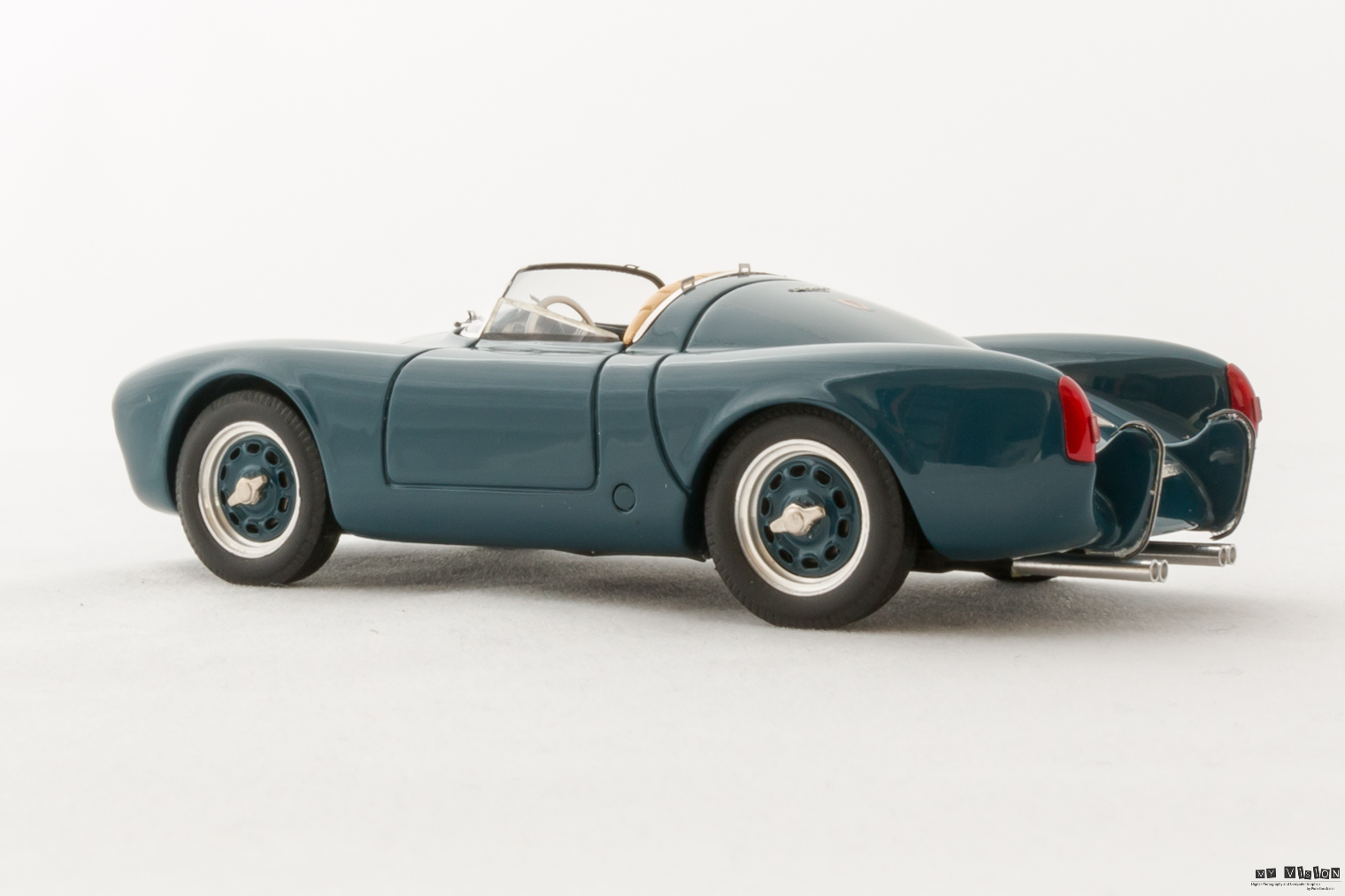
Porsche 550 Bucklespyder

Monday 4 July 2016
The Porsche 550 was a racing sports car produced by Porsche from 1953-1956.
Inspired by the Porsche 356 which was created by Ferry Porsche, and some spyder prototypes built and raced by Walter Glöckler starting in 1951, the factory decided to build a car designed for use in auto racing. The model Porsche 550 Spyder was introduced at the 1953 Paris Auto Show. The 550 was very low to the ground, in order to be efficient for racing. In fact, former German Formula One racer Hans Herrmann drove it under closed railroad crossing gates during the 1954 Mille Miglia.
The first three hand built prototypes came in a coupé with a removable hardtop. The first (550-03) raced as a roadster at the Nurburgring Eifel Race in May 1953 winning its first race. Over the next couple of years, the Werks Porsche team evolved and raced the 550 with outstanding success and was recognized wherever it appeared. The Werks cars were provided with differently painted tail fins to aid recognition from the pits. Hans Herrmann’s particularly famous ‘red-tail’ car No 41 went from victory to victory. Porsche was the first car manufacturer to get race sponsorship which was through Fletcher Aviation, who Porsche was working with to design a light aircraft engine and then later adding Telefunken and Castrol.
For such a limited number of 90 prototype and customer builds, the 550 Spyder was always in a winning position, usually finishing in the top three results in its class. The beauty of the 550 was that it could be driven to the track, raced and then driven home, which showed the flexibility of being both a road and track car. Each Spyder was individually designed and customised to be raced and although from the pits it was difficult to identify the sometimes six 550s in the race, the aid of colouring tail spears along the rear wheel fenders, enabled the teams to see their cars. The racing Spyders were predominantly silver in colour, similar to the factory colour of the Mercedes, but there were other splashes of blue, red, yellow and green in the tail spears making up the Porsche palette on the circuit.
Each Spyder was assigned a number for the race and had gumballs positioned on doors, front and rear, to be seen from any angle. On some 550s owned by privateers, a crude hand written number scrawled in house paint usually served the purpose. Cars with high numbers assigned such as 351, raced in the 1000 mile Mille Miglia, where the number represented the start time of 3.51am. On most occasions, numbers on each Spyder would change for each race entered, which today helps identify each 550 by chassis number and driver in period black and white photos.
The later 1956 evolution version of the model, the 550A, which had a lighter and more rigid spaceframe chassis, gave Porsche its first overall win in a major sports car racing event, the 1956 Targa Florio.
Its successor from 1957 onwards, the Porsche 718, commonly known as the RSK was even more successful. The Spyder variations continued through the early 1960s, the RS 60 and RS 61. A descendant of the Porsche 550 is generally considered to be the Porsche Boxster S 550 Spyder; the Spyder name was effectively resurrected with the RS Spyder Le Mans Prototype.

Technical data:
- engine: 4 cylinders
- capacity: 1498 cc
- horsepower: 110 HP
- gearbox: 4+1
- top speed: 220 km/h

Porsche 901

Monday 4 July 2016
Porsche 901 was the name originally intended for the Porsche 911.
By the early 1960s, Porsche project design numbers had reached into the 800s. For instance, Porsche's 1962 F1 model was called Porsche 804.
At the Internationale Automobil-Ausstellung (Frankfurt Motor Show) in Frankfurt in September 1963, Porsche presented its successor to the Porsche 356 as the 901. It took several more months until the cars were manufactured for sale to customers. Between 14 September and 16 November 1964, 82 cars were built and the 901 was presented in October at the 1964 Paris Auto Salon. There, French car maker Peugeot objected to Porsche using any three digit number where the middle number was 0, asserting ownership of the naming rights in key markets, and having already sold many models with that scheme.
So, Porsche simply replaced the middle 0 with a 1, and called the car Porsche 911. Officially the 901s already constructed were used for testing and for exhibitions, and Porsche sold none to private customers. Nevertheless, several of the cars retained by Porsche at that time appear to have made it to private ownership subsequently: in 1988 number 20 was discovered and completely restored by Kurt Schneider and his wife, Lori. Then in 2010 it was reported that car number 37 was owned by a Porsche specialist named Alois Ruf.

Technical data:
- engine: 4 cylinders
- capacity: 2341 cc
- horsepower: 130 HP
- gearbox: 5+1
- top speed: 205 km/h

Porsche 924 Turbo Kombi Artz

Friday 12 February 2016
I am usually against tuning, but this example of well known 924 converted into shooting brake is fantastic!

Technical data:
- engine: 4 cylinders
- capacity: 1984 cc
- horsepower: 127 HP
- gearbox: 5+1
- top speed: 203 km/h

Porsche 356 1600

Tuesday 24 September 2013
The 356 was a lightweight and nimble-handling rear-engine rear-wheel-drive 2-door sports car available in hardtop coupe and open configurations. Design innovations continued during the years of manufacture, contributing to its motorsports success and popularity. Production started in 1948 at Gmünd, Austria, where approximately 50 cars were built. In 1950 the factory relocated to Zuffenhausen, Germany, and general production of the 356 continued until April 1965, well after the replacement model 911 made its autumn 1963 debut. Of the 76,000 originally produced, approximately half survive.
Prior to World War II Porsche designed and built three Type 64 cars for a 1939 Berlin to Rome race that was cancelled. In 1948 the mid-engine, tubular chassis 356 prototype called "No. 1" was completed. This led to some debate as to the "first" Porsche automobile, but the 356 is considered by Porsche to be its first production model.
The 356 was created by Ferdinand "Ferry" Porsche (son of Dr. Ing. Ferdinand Porsche, founder of the company). Like its cousin, the Volkswagen Beetle (which Ferdinand Porsche Senior had designed), the 356 was a four-cylinder, air-cooled, rear-engine, rear-wheel-drive car utilizing unitized pan and body construction. While the 356's body was an original design by Porsche employee Erwin Komenda, its mechanicals (including engine case and suspension components)were based on and initially sourced from Volkswagen. The first 356 was road certified in Austria on June 8, 1948, and used many Volkswagen parts for manufacturing economy. Quickly though, Porsche re-engineered and refined the car with a focus on performance. It is interesting to note that they had introduced the 4-cam racing "Carrera" engine (a design totally unique to Porsche sports cars) before they introduced their own, non-VW pushrod engine case in late 1954. Fewer and fewer parts were shared between Volkswagen and Porsche as the '50's progressed. The early 356 automobile bodies produced at Gmünd were handcrafted in aluminum, but when production moved to Zuffenhausen, Germany in 1950, models produced there were steel-bodied. Looking back, the aluminum bodied cars from that very small company are what we now would refer to as prototypes.
Little noticed at its inception, mostly by a small number of auto racing enthusiasts, the first 356s sold primarily in Austria and Germany. It took Porsche two years, starting with the first prototype in 1948, to manufacture the first 50 automobiles. By the early 1950s the 356 had gained some renown among enthusiasts on both sides of the Atlantic for its aerodynamics, handling, and excellent build quality. The class win at Le Mans in 1951 was clearly a factor. It was always common for owners to race the car as well as drive them on the streets. Increasing success with its racing and road cars brought Porsche orders for over 10,000 units in 1964, and by the time 356 production ended in 1965 approximately 76,000 had been produced.
The basic design of the 356 remained the same throughout its lifespan, with evolutionary, functional improvements rather than annual superficial styling changes. Nevertheless a variety of models in both coupe and convertible forms were produced from 1948 through 1965.
Cabriolet models (convertibles with a full windshield and padded top) were offered from the start, and in the early 1950s sometimes comprised over 50% of total production. One of the most desirable collector models is the 356 "Speedster", introduced in late 1954 after Max Hoffman, the sole US importer of Porsches, advised the company that a lower-cost, somewhat spartan open-top version could sell well in the American market. With its low, raked windscreen (which could be removed for weekend racing), bucket seats and minimal folding top, the Speedster was an instant hit, especially in Southern California. Production of the Speedster peaked at 1,171 cars in 1957 and then started to decline. It was replaced in late 1958 by the "Convertible D" model.[5] It featured a taller, more practical windshield (allowing improved headroom with the top erected), roll-up glass side-windows and more comfortable seats. The following year the 356B "Roadster" convertible replaced the D model but the sports car market's love affair with top-down motoring was fading; soft-top 356 model sales declined significantly in the early 1960s. Today these early four-cylinder models are highly coveted by collectors and enthusiasts worldwide.
To distinguish among the major revisions of the model, 356's are generally classified into a few major groups. 356 coupes and "cabriolets" (soft-top) built through 1955 are readily identifiable by their split (1948 to 1952) or bent (centre-creased, 1953 to 1955) windscreens. In late 1955, with numerous small but significant changes, the 356A was introduced. Its internal factory designation, "Type 1", gave rise to its nickname "T1" among enthusiasts. In early 1957 a second revision of the 356A was produced, known as Type 2 (or T2). In late 1959 more significant styling and technical refinements gave rise to the 356B (a T5 body type).
The mid-1962 356B model was changed to the T6 body type (twin engine lid grilles, an external fuel filler in the right front wing/fender and larger windows). A unique "Karmann Hardtop" or "Notchback" 356B model was produced in 1961 and 1962. The 1961 production run was essentially a cabriolet body with the optional steel cabriolet hardtop welded in place. The 1962 line (T6 production) was a very different design in that the new T6 notchback coupé body did not start life as a cabriolet, but with its own production design—In essence, part cabriolet rear end design, part T6 coupe windshield frame, unique hard top. Both years of these unique cars have taken the name "Karmann Notchback".
The last revision of the 356 was the 356C introduced for the 1964 model year. It featured disc brakes all round, as well as an option for the most powerful pushrod engine Porsche had ever produced, the 95 hp (71 kW) "SC". 356 production peaked at 14,151 cars in 1964, the year that its successor, the new 911, was introduced to the US market (it was introduced slightly earlier in Europe). The company continued to sell the 356C in North America through 1965 as demand for the model remained quite strong in the early days of the heavier and more "civilized" 911. The last ten 356's (cabriolets) were assembled for the Dutch police force in March 1966 as 1965 models.
The 356's four-cylinder pushrod engine was later re-introduced in Porsche's "entry-level" 912 model, offered between 1965 and 1969 as response to customer complaints that the new 911 (at nearly twice the price of the 356) was too expensive. Although in some ways the 912 did reprise the 356's specifications, it would not be accurate to say the 912 was successor to the 356; when the decision was made to replace the 356, the 911 was the only car intended to carry the Porsche name forward. Rather the 912 was an afterthought intended to supply the lower-priced end of the market, which the expensive, complex but faster and heavier 911 could not do.


Technical data:
- engine: 4 cylinders boxer
- capacity: 1600 cc
- horsepower: 95 HP
- gearbox: 4+1
- top speed: 200 km/h