Pokazywanie postów oznaczonych etykietą Kyosho. Pokaż wszystkie posty

Nissan Prince Skyline Coupe

Tuesday 11 June 2013
The Nissan Skyline is a line of compact cars, sports cars and compact executive cars originally produced by the Prince Motor Company starting in
1955, and then by Nissan after the two companies merged in 1966. After the merger, the Skyline and its larger counterpart, the Nissan Gloria, were sold in Japan at dealership sales channels called Nissan Prince Shop.
Unfortunatelly there is not nuch information on this model available in Languages other than Japanese. If anyone has any info, please share.


Technical data:
- engine: 4 cylinders
- capacity: 1962 cc
- horsepower: 96 HP
- gearbox: 4+1
- top speed: 155 km/h

Mazda RX7

Friday 12 April 2013
The Mazda RX-7 is a sports car produced by the Japanese automaker Mazda from 1978 to 2002. The original RX-7 featured a 1146 cc twin-rotor Wankel rotary engine and a front-midship, rear-wheel drive layout. The RX-7 replaced the RX-3 (both were sold in Japan as the Savanna) and later replaced all other Mazda rotary-engine cars except the Cosmo.
The original RX-7 was a sports car with pop-up headlamps. The compact and lightweight Wankel engine (rotary engine) is situated slightly behind the front axle, a configuration marketed by Mazda as "front mid-engine". It was offered as a two-seat coupé, with optional "occasional" rear seats in Japan, Australia, the United States, and other parts of the world. These rear seats were initially marketed as a dealer-installed option for the North American markets.
The RX-7 made Car and Driver magazine's Ten Best list five times. 811,634 RX-7s were produced.
Series 1 (1978–1980) is commonly referred to as the "SA22C" from the first alphanumerics of the vehicle identification number. This series of RX-7 had exposed steel bumpers and a high-mounted indentation-located license plate, called by Werner Buhrer of Road & Track magazine a "Baroque depression." In Japan it was introduced in March 1978, replacing the Savanna RX-3.
In May 1980, Mazda released 2,500 special North American models known as the LS (Leather Sport). This package was essentially an uprated GS model with added LS badges on each B-pillar, special striping, and LS-only gold anodized wheels (with polished outer face and wheel rim). All LS editions came equipped with special LS-only full brown leather upholstery, leather wrapped steering wheel, leather wrapped shift knob, removable sunroof, LS-specific four-speaker AM/FM stereo radio with power antenna (though listed as a six speaker stereo, as the two rear dual voice coil speakers were counted as four speakers in total), remote power door side mirrors, and other standard GS equipment. Two primary options were also available; a three-speed JATCO 3N71B automatic transmission and air conditioning. Other GS options such as cassette tape deck, splash guards, padded center console arm rest and others could be added by the dealer. The LS model was only ever available in three different exterior colors: Aurora White (1,000 made), Brilliant Black (1,000 made) and Solar Gold (500 made). Production estimates in parenthesis are widely accepted estimations per color, though no official production records are known to exist or to have been released, aside from the total combined production figure of 2,500 units.
The Series 2 (1981–1983) had integrated plastic-covered bumpers, wide black rubber body side moldings, wraparound taillights and updated engine control components. The GSL package provided optional four-wheel disc brakes, front ventilated (Australian model) and clutch-type rear limited slip differential (LSD). Known as the "FB" in North America after the US Department of Transportation mandated 17 digit Vehicle Identification Number changeover. For various other markets worldwide, the 1981–1985 RX-7 retained the 'SA22C' VIN prefix. In the UK, the 1978–1980 series 1 cars carried the SA code on the vehicle VIN but all later cars (1981–1983 series 3 & 1984–1985 series 3) carried the FB code and these first generation RX7's are known as the "FB". The license-plate surround looks much like Buhrer's "Styling Impressions."
In Europe, the FB was mainly noticed for having received a power increase from the 105 PS (77 kW) of the SA22; the 1981 RX-7 now had 115 PS (85 kW) on tap. European market cars also received four-wheel disc brakes as standard.
The Series 3 (1984–1985) featured an updated lower front fascia. North American models received a different instrument cluster (the NA S3 RX-7 is the only rotary-engined car to not have a centrally mounted tachometer). GSL package was continued into this series, but Mazda introduced the GSL-SE sub-model. The GSL-SE had a fuel-injected 1.3 L 13B RE-EGI engine producing 135 hp (101 kW) and 135 lb·ft (183 N·m). GSL-SEs had much the same options as the GSL (clutch-type rear LSD and rear disc brakes), but the brake rotors were larger, allowing Mazda to use the more common lug nuts (versus bolts), and a new bolt pattern of 4x114.3 (4x4.5"). Also, they had upgraded suspension with stiffer springs and shocks. The external oil cooler was reintroduced, after being dropped in the 1983 model-year for the controversial "beehive" water-oil heat exchanger.
The 1984 RX-7 GSL has an estimated 29 highway miles per gallon (8.11 litres per 100 km) /19 estimated city miles per gallon (12.37 l/100 km). According to Mazda, its rotary engine, licensed by NSU-Wankel allowed the RX-7 GSL to accelerate from 0 to 50 (80 km/h) in 6.3 seconds. Kelley Blue Book, in its January–February 1984 issue, noted that a 1981 RX-7 GSL retained 93.4% of its original sticker price.
In 1985 Mazda released the RX7 Finale in Australia. This was the last of the series and brought out in limited numbers. The Finale featured power options and a brass plaque mentioning the number the car was as well as "Last of a legend" on the plaque. The finale had special stickers and a blacked out section between the window & rear hatch.
The handling and acceleration of the car were noted to be of a high caliber for its day. This generation RX-7 had "live axle" 4-link rear suspension with Watt's linkage, a 50/50 weight ratio, and weighed under 2,500 lb (1,100 kg). It was the lightest generation of RX-7 ever produced. 12A-powered models accelerated from 0–60 mph in 9.2 s, and turned 0.779 g (7.64 m/s²) laterally on a skidpad. The 12A engine produced 100 hp (75 kW) at 6,000 rpm, allowing the car to reach speeds of over 120 miles per hour (190 km/h). Because of the smoothness inherent in the Wankel rotary engine, little vibration or harshness was experienced at high engine speeds, so a buzzer was fitted to the tachometer to warn the driver when the 7,000 rpm redline was approaching.
The 12A engine has a long thin shaped combustion chamber, having a large surface area in relation to its volume. Therefore, combustion is cool, giving few oxides of nitrogen. However, the combustion is also incomplete, so there are large amounts of partly burned hydrocarbons and carbon monoxide. The exhaust is hot enough for combustion of these to continue into the exhaust. An engine driven pump supplies air into the exhaust to complete the burn of these chemicals. This is done in the "thermal reactor" chamber where the exhaust manifold would normally be on a conventional engine. Under certain conditions the pump injects air into the thermal reactor and at other times air is pumped through injectors into the exhaust ports. This fresh air is needed for more efficient and cleaner burning of the air/fuel mixture.


Technical data:
- engine: 4 cylinders
- capacity: 1308 cc
- horsepower: 135 HP
- gearbox: 5+1
- top speed: 195 km/h

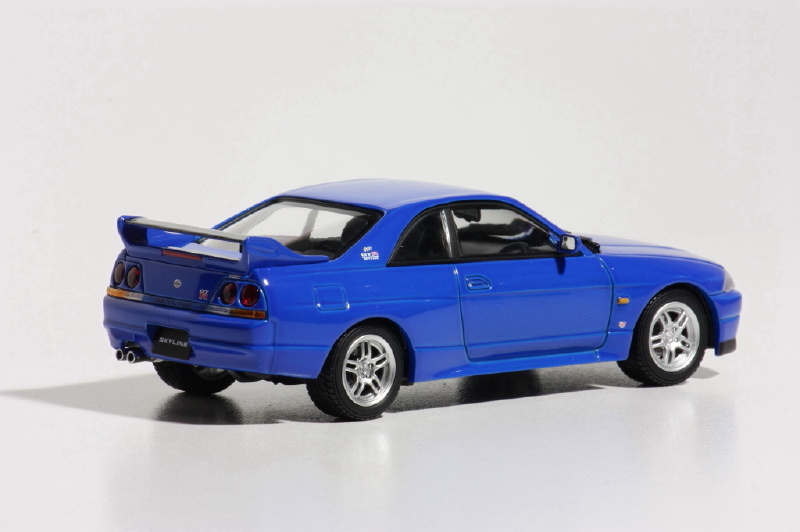
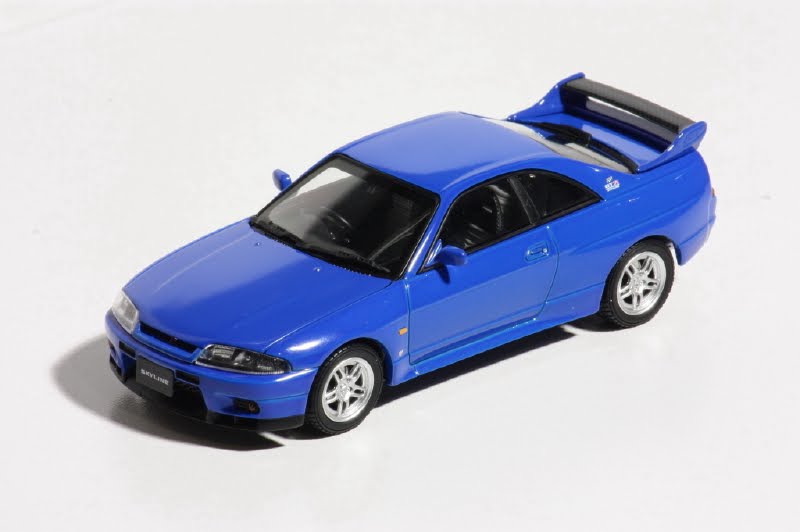
Nissan Skyline GTR33

Thursday 21 June 2012
The E-BCNR33 (R33) was developed in 1995 as a successor to the venerable R32 model. The engine in the R33 was nearly identical to the R32. It used the same turbochargers and the same specification for the manual gearbox, although the syncros were made to be stronger. The engine corrected the R32's weak oil pump drive collar, which tended to fail in higher power applications, with a wider collar. The base model R33 GT-R weighs 1,540 kg (3,400 lb).
The R33 GT-R launched in January 1995 with the base model GT-R and the V-spec model. The V-spec model weighed in 10 kg (22 lb) heavier, and had sportier suspension resulting in lower ground clearance. The V-spec also featured the newer ATTESA E-TS Pro all wheel drive system, which included an Active Limited Slip differential. The V-spec model also included a four wheel independent channel anti-lock braking system.
At the same time as the release of the R33 GT-R and GT-R V-spec, Nissan released the R33 GT-R V-spec N1 model. Changes made in the R33 N1 are similar to those in the R32 N1. The car was made lighter by removing the ABS, air conditioning, sound system, rear wiper and trunk carpet. The R33 GT-R V-spec N1 received the slightly revised R33 N1 engine.
A special edition R33 was released on November 3, 1997 called the 400R, with R standing for Racing. Overall development and planning was by NISMO (Nissan Motorsports International). But, its bored and stroked RB26DETT engine, the RBX-GT2, was engineered and produced by REINIK (later renamed REIMAX – "REINIK to the MAX"). The engine featured 77.7 mm stroke crankshaft (73.7 mm stock), forged 87 mm pistons (86 mm cast stock), upgraded rods, polished ports, high lift camshafts, upgraded oil system, larger exhaust manifolds and higher output turbochargers. NISMO produced an upgraded exhaust, a twin-plate clutch, and intercooler system. Nismo brake pads were fitted to the car. 400R exclusive aerodynamic updates were also added, such as wider fenders, side skirts, a new rear bumper, a new front bumper with bigger air scoops, and a redesigned bonnet and rear spoiler made of carbon fiber. The 400R was also fitted with 18x10 Nismo LM-GT1s. The car developed 300 kW (400 hp) and 347 lb·ft (470 N·m), which allowed a top speed of over 186 mph (300 km/h), and enabled it to reach 0–97 km/h in 4.0 seconds. 370 kW (500 hp) is easily achieved with a higher boost setting. NISMO had originally planned to produce 100 units of the 400R, however only 44 units were made before production of the R33 ended in 1998.

Technical data:
- engine: 6 cylinders
- capacity: 2600 cc
- horsepower: 500 HP
- gearbox: 5+1
- top speed: 300 km/h

Lotus Europa

Saturday 16 June 2012
The Lotus Europa is a two door mid-engined GT coupé built by Lotus Cars from 1966 to 1975. In 2006 Lotus began production of a totally new, Lotus Elise-derived design, a mid-engined GT coupé named Europa S.
The original Europa used Lotus founder Colin Chapman's minimalist steel backbone chassis that was first used in the Lotus Elan, while also relying on its fibreglass moulded body for structural strength. The Europa was based on a prototype built to compete for Henry Ford II's contract to build a Le Mans race car in the early 1960s.
The Europa was designed and built to be an embodiment of Chapman's oft-stated philosophy of automotive design: "Simplify, then add lightness."
The four-wheel independent suspension was typical of Chapman's thinking. The rear suspension was a modified Chapman strut, as used for Chapman's earlier Formula racing car designs. Owing to the rubber suspension bushes used to isolate engine vibration from the car body, the true Chapman strut's use of the drive shaft as the lower locating link could not be followed whilst still giving the precise track and handling desired. The forward radius arms were increased in size and rigidity, to act as a semi-wishbone. A careful compromise between engine mounting bush isolation and handling was required, culminating eventually in a sandwich bush that was flexible against shear but stiff in compression and tension. The car's handling prompted automotive writers to describe the Europa as the nearest thing to a Formula car for the road. Aside from the doors, bonnet (hood), and boot (trunk), the body was moulded as a single unit of fibreglass.
In all, Lotus built about 9,300 Europas.

Technical data:
- engine: 4 cylinders
- capacity: 1600 cc
- horsepower: 80 HP
- gearbox: 4+1
- top speed: 187 km/h

Toyota Supra 2.0 Twinturbo

Friday 6 April 2012
In May 1986, Toyota was ready to release its next version of the Supra. The bonds between the Celica and the Supra were cut; they were now two completely different models. The Celica changed to front wheel drive, while the Supra kept its rear wheel drive platform. Though the Mark II and Mark III had similar designs, the engine was updated to a more powerful 3.0 200 hp (149 kW) inline 6. Although only available in naturally aspirated trim in 1986.5, a turbocharged version of the engine was introduced in the 1987 model year. The Supra was now related mechanically to the Toyota Soarer for the Japanese market.
The new Mark III Supra engine, the Toyota 7M-GE, was the flagship engine of Toyota's arsenal. Both versions of the engine contained 4 valves per cylinder and dual overhead cams. The turbocharged 7M-GTE engine was Toyota's first distributor-less engine offered in the US which used coil packs sitting on the cam covers and a cam position sensor driven by the exhaust camshaft. It was equipped with a CT26 turbocharger and was rated at 230 hp (172 kW) at 5600 rpm while the naturally aspirated 7M-GE engine was rated at 200 hp (149 kW) at 6000 rpm. Further refinement on the turbo model increased power to 232 hp (173 kW) and 254 lb·ft (344 N·m) in 1989. This was mostly due to a redesign of the wastegate.
Due to a large error in the factory head bolt torque specifications, all of these engines had severe problems with blown head gaskets. Toyota never issued a recall for any of the affected vehicles. The problem could be easily fixed by replacing the head gasket and torquing the head bolts to 75 lb·ft (102 N·m) of torque. However, due to the lack of a recall or appropriate service bulletin, the head gasket problem would recur if the gasket was replaced and the bolts were retorqued to the erroneous service manual specifications. With the head bolts torqued correctly, the engines were otherwise extremely durable.

Engine: L6
Capacity: 2491 cc
Power: 276 HP
Gearbox: 5+1
Top Speed: 250 km/h