Pokazywanie postów oznaczonych etykietą Simca. Pokaż wszystkie posty

Simca 8

Thursday 28 January 2016
The Simca 8 was a large family car built by Simca and sold in France between November 1937 and 1951 (including wartime), available as a saloon, coupé or cabriolet. It was a rebadged Fiat 508C "nuova Balilla" made at Fiat's Simca plant in Nanterre, France.
At launch only two bodies were offered, these being a 4-door "berline" (saloon/sedan) and a 2-door cabriolet. This contrasted with the Simca's Italian cousin for which a wider range of bodies was available from the start and it also marked a departure from the strategy followed by Simca themselves with the predecessor model, the Simca-Fiat 6CV which had been offered with almost as wide a range of body variants as its Turin built relative. The 4-door saloon body was unusual in that there was no central pillar between the front doors, hinged at the front, and the rear doors, hinged at the back, permitting particularly easy access when a front and rear door were opened simultaneously. In 1937 the Simca 8 4-door Berline was priced at 23,900 Francs for a "Normale" version and at 25,900 Francs for a "Grande Luxe". The Peugeot 202 made its debut only six months later, in Spring 1938, and was priced at 21,300 Francs for a "Normale" version and at 22,500 Francs for a "Luxe". The cars were similar in size and power, but sales data suggest that the market found space for both of them, despite the Simca's higher price.
The post war range became wider, with coupé, cabriolet and after 1948 estate versions listed, but these were all substantially more expensive than the berline: virtually all the cars sold were still Simca 8 Berlines, which early in 1947 were priced at 330,000 francs against 420,000 francs for the cabriolet. (The slightly longer but slightly slower competitor from Peugeot, the 202 was priced at 303,600 francs which included a sunroof at no extra cost.)
Over the course of a few years the Simca 8 underwent some grille changes, and other minor upgrades.
The Simca 8 won plaudits for its lively temperament and excellent fuel economy. The four ratios on the new gear box were chosen so that even when cruising at 110 km/h (68 mph) fuel consumption remained reasonable, and set to permit good progress along country roads and reasonable acceleration even in hilly areas. The car also came with unusually precise steering and efficient hydraulically controlled brakes that did not overheat.
Commentators nevertheless noted that the engine was noisy when working hard, the (semaphore style) direction indicators were fragile, and the ambitiously sophisticated front suspension also proved fragile when confronted with France's rural roads, many of which were still unpaved. The gear box could be disagreeable when changing down across the gate from third speed to second, and the car was only just large enough for four people, with only a small storage area for luggage, located in a hard to get at position behind the back seat and without any external access.

Technical data:
- engine: 4 cylinders
- capacity: 1090 cc
- horsepower: 32 HP
- gearbox: 3+1
- top speed: 110 km/h

Simca 1100 Fourgon

Sunday 20 September 2015
The 1100 was the result of "Project 928", started in 1962, finalized by engineers Philippe Grundeler and Charles Scales. The design was a result of Simca's market research in the early 1960s, which showed the increasing popularity of front wheel drive cars that provided better utilization of space and comfort in small cars. In Spring 1962, Simca organized a 1966–67 launch of a new range of front wheel drive cars with saloons, estates cars and light commercial vehicles to be included, all fitting into France's 6CV tax class – between the Simca Mille and Simca 1300. Both transverse and longitudinal engine placement were tested, and in 1963 the transverse-engine design was approved. The Simca 1100 was one of the first designs outside Fiat to feature a transverse engine with an end-on gearbox and unequal length driveshafts (now near-universal amongst small cars), a possible result of Fiat influence as a major shareholder.
In 1963, Chrysler took a controlling interest in Simca, approving the project in 1964, with a production target of summer 1967. The short timetable included developing a new transmission, and using a larger version of the rear engined rear wheel drive Simca Mille (Simca 1000) "Poissy engine", displacing 1118 cc (the Mille used a 1.0 litre engine, the 1500 a 1.5 litre engine).
During the first full year of production 1968, volumes were already strong with 138,242 vehicles made. Importantly, incremental sales appeared to come mostly from competitor manufacturers, since overall Simca production surged from 251,056 cars in 1967 to 350,083 in 1968, and volumes for the slightly smaller Simca 1000 were virtually identical in each of these two years.
Production peaked in 1973, with nearly 300,000 Simca 1100s rolling off the assembly line. However, production fell rapidly through 1977, when over 142,000 1100s were made, and in 1978 (with the Chrysler Horizon launched in February 1978), just half that number (72,695) of Simca 1100s was made. Volumes dwindled to below 20,000 in 1981 which was the last year of production in France, though in Spain production continued through to 1982 of the car and 1985 for the van version.

Technical data:
- engine: 4 cylinders
- capacity: 1118 cc
- horsepower: 52 HP
- gearbox: 5+1
- top speed: 145 km/h

Simca 1301

Monday 27 October 2014
imca 1300 and Simca 1500 were large family cars manufactured by the French automaker Simca in its Poissy factory from 1963 to 1966, and between 1966 and 1975 in revamped versions, as Simca 1301 and Simca 1501.
They were essentially versions of the same car, fitted with either a 1.3 L or 1.5 L engine, hence the model names. Apart from different engines and differences in standard equipment, the models were for the most part identical, bar some styling details such as grille or bumpers. This model series replaced the popular, long-running Simca Aronde and was initially available only with a 4-door saloon body, but in 1964 the 1500 gained an estate version (1300 estate followed in 1965).
The estate versions had some interesting features. All had split tailgates - the rear windscreen would wind down into the bottom part, which could then be folded down. On the one hand, this allowed the access to the cargo compartment without opening the full tailgate. On the other, this meant that a rear window heater could never be installed in estates. Additionally, the 1500 GL version's cargo floor, which doubled as the cover for the spare wheel (stowed flat), could be removed and, thanks to four folding legs, converted into a picnic table! A 1500 Familial version had two child seats (facing each other) in the cargo compartment, and a luggage rack on the roof.
In September 1966 Simca presented the revised range, now bearing the 1301/1501 names. The saloons featured a new, extended front end, and a significantly stretched rear, which resulted in a larger boot and a more stately profile. The estates, while also receiving the new front end, retained their previous rear design. All models were also given new interiors. In 1969 and 1970 respectively, Simca presented the more "sporty" Special versions of the 1501 and 1301. The range continued to be produced until 1975, when Simca unveiled a replacement, the Simca 1307, which went on to become the 1976 European Car of the Year.
While being quite popular, especially in France and Germany, those Simcas can be remembered for some quirks regarding both series. The 1300/1500 came with column shift for left-hand drive markets, but the right-hand drive versions were converted to floor shift. The conversion for some reason resulted in a "mirror" shift pattern, with the first and second gear being closer to the driver, and the third and fourth farther to the left.
Moreover, the 1500 GLA model, which was initially the sole in the range featuring automatic transmission, was at first available in metallic brown only. A similar situation concerned the interior carpets, which would come deep red regardless of the exterior color. On 1301/1501 models from 1970 onwards a new badging scheme was used, which employed a red paint with a propensity to fade over time, resulting in the badges (and thus the model denomination) becoming unintelligible.

Technical data:
- engine: 4 cylinders
- capacity: 1290 cc
- horsepower: 63 HP
- gearbox: 4+1
- top speed: 145 km/h

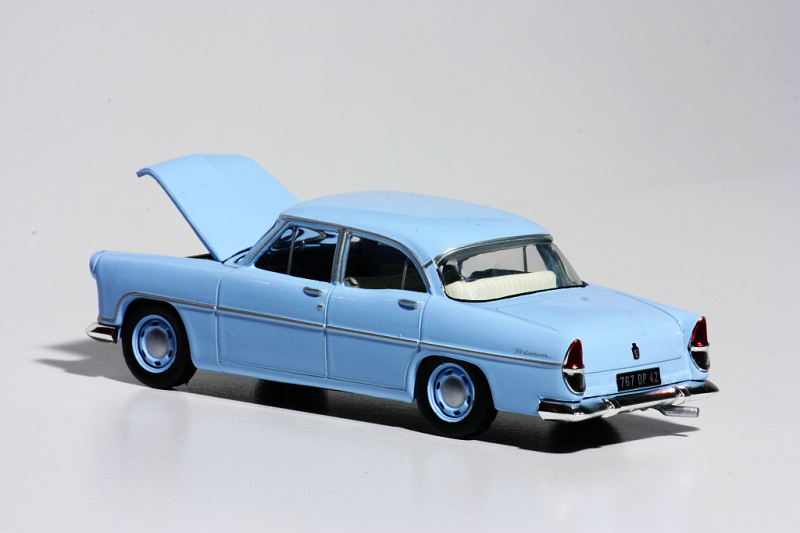
Simca Trianon

Wednesday 5 December 2012
The Simca Vedette is a large car, manufactured from 1954 to 1961 by the French automaker Simca, at their factory in Poissy, France. It was marketed with different model names according to trim and equipment levels. The Vedette was Simca's largest model at that time and it spawned a more economical version, the Simca Ariane.
Simca acquired the Poissy factory from Ford France (Ford Société Anonyme Française, the French subsidiary of the Ford Motor Company), along with the model line, in 1954. The Vedette was therefore initially still marketed as the Ford Vedette.
The Vedette was manufactured in Poissy until 1961 and the Ariane until 1963. After that, production continued in Brazil, where the Vedette finally evolved into the Simca Esplanada, following Simca's takeover by Chrysler.
In the early 1950s, Henri Théodore Pigozzi was looking to expand the manufacturing operations of his Simca company, which was enjoying much success at the time, thanks to the popular Aronde. At the same time, Ford was seeking to divest itself of its French subsidiary, Ford SAF, which had a factory in Poissy, close to Paris, where it had been manufacturing a large car called the Ford Vedette. The Poissy plant was large and there was capacity for further expansion. The Vedette was a larger car than anything that Simca had on offer at that time. These points attracted Pigozzi, who decided to take over the entire factory, along with the rights to the cars manufactured there.
The acquisition by Pigozzi took place in July 1954, just when Ford was poised to launch its new, modern Vedette, with a four-door saloon body of "American" style, much like the contemporary British Fords or Vauxhalls. The car was powered by an unusually small 2,351 cc sidevalve V8 engine called Aquillon in France, derived from Ford's Flathead engine family, the dimensions of which put the car into the "13 CV" French tax class. Equipped with a two-barrel Zenith-Stromberg 32NX carburetor, it produced 75 to 84 hp (56 to 63 kW). Power was transferred to the rear live axle through a three-speed manual transmission with column shift. The Vedette had independent front suspension (by MacPherson struts) and drum brakes on all four wheels.
As with the Aronde, Simca marketed different trim levels of the Vedette under different model names, this time with references to the grand period of baroque in French history. The basic version was called the Simca Vedette Trianon, the mid-level was the Simca Vedette Versailles and, at the top of the range, the Simca Vedette Régence. An interesting option on all versions was a large glass moonroof that slid into the roof, called Vistadome The Vedette range was still marketed under the Ford brand in some markets, including the Netherlands and Germany, until 1956. As the new model caught on, Simca was able to increase production from the 150 daily achieved during Ford's ownership of the factory to 250 cars a day.
Pigozzi maintained a schedule of year-to-year model revisions, much like American manufacturers. For 1956, an estate version called the Simca Vedette Marly joined the line-up and the whole range was revised. A new license plate holder was added to the front bumper and the rear license plate now concealed the fuel tank filler. A peculiar addition was a pedal-operated windscreen washer, while other more ordinary changes included a second odometer, also known as a 'trip meter', for measuring partial distances. The Versailles and Régence were made even more comfortable with the addition of central armrests (Versailles in the rear only, Régence in front and rear), while the Trianon was simplified, losing bumper guards and chrome windscreen decor. In 1957, an option of the Gravina automatic clutch was added, along with better brakes and more direct steering. The Trianon regained the chrome decor around the windscreen, while the other models acquired slimmer tail lights and the front ornament was replaced with a new design. Fender-mounted V8 badges were introduced but, although the whole range featured the same V8 engine, the new badges appeared on the fenders of only the Régence and Marly.

Technical data:
- engine: V8
- capacity: 2351 cc
- horsepower: 84 HP
- gearbox: 3+1
- top speed: 145 km/h

Simca 1501S

Tuesday 4 December 2012
Simca 1300 and Simca 1500 were large family cars manufactured by the French automaker Simca in its Poissy factory from 1963 to 1966, and between 1966 and 1975 in revamped versions, as Simca 1301 and Simca 1501.
They were essentially versions of the same car, fitted with either a 1.3 L or 1.5 L engine, hence the model names. Apart from different engines and differences in standard equipment, the models were for the most part identical, bar some styling details such as grille or bumpers. This model series replaced the popular, long-running Simca Aronde and was initially available only with a 4-door saloon body, but in 1964 the 1500 gained an estate version (1300 estate followed in 1965).
The estate versions had some interesting features. All had split tailgates - the rear windscreen would wind down into the bottom part, which could then be folded down. On the one hand, this allowed the access to the cargo compartment without opening the full tailgate. On the other, this meant that rear window heater could never be installed in estates. Additionally, the 1500 GL version's cargo floor, which doubled as the cover for the spare wheel (stowed flat), could be removed and, thanks to four folding legs, converted into a picnic table! A 1500 Familial version had two child seats (facing each other) in the cargo compartment, and a luggage rack on the roof.
In September 1966 Simca presented the revised range, now bearing the 1301/1501 names. The saloons featured a new, extended front end, and a significantly stretched rear, which resulted in a larger boot and a more stately profile. The estates, while also receiving the new front end, retained their previous rear design. All models were also given new interiors. In 1969 and 1970 respectively, Simca presented the more "sporty" Special versions of the 1501 and 1301. The range continued to be produced until 1975, when Simca unveiled a replacement, the Simca 1307, which went on to become the 1976 European Car of the Year.
While being quite popular, especially in France and Germany, those Simcas can be remembered for some quirks regarding both series. The 1300/1500 came with column shift for left-hand drive markets, but the right-hand drive versions were converted to floor shift. The conversion for some reason resulted in a "mirror" shift pattern, with the first and second gear being closer to the driver, and the third and fourth farther to the left.
Moreover, the 1500 GLA model, which was initially the sole in the range featuring automatic transmission, was at first available in metallic brown only. A similar situation concerned the interior carpets, which would come deep red regardless of the exterior color. On 1301/1501 models from 1970 onwards a new badging scheme was used, which employed a red paint with a propensity to fade over time, resulting in the badges (and thus the model denomination) becoming unintelligible.

Technical data:
- engine: 4 cylinders
- capacity: 1500 cc
- horsepower: 65 HP
- gearbox: 4+1
- top speed: 135 km/h

Simca 1000 Rallye 3

Tuesday 4 December 2012
The Simca 1000 was a small, rear-engined, four-door saloon manufactured by the French automaker Simca from 1961 to 1978.
The car was inexpensive and, at the time of launch, quite modern, with a brand-new inline-4 watercooled engine of (at this stage) 944cc. Production began on 27 July 1961, with the official launch taking place at the Paris Motor Show on 10 October 1961.
At the time of the launch, cars could be ordered in one of three colours (red/rouge tison, egg-shell blue/bleu pervenche or off-white/gris-princesse). However, the show stand featured two additional body colours and the range of colours available to customers was soon expanded. The company's marketing strategy was characteristically imaginitive, and having acquired a Paris taxi business in 1958, in November 1961 Simca replaced 50 of that company's Simca Ariane based taxis with 50 much smaller (but evidently spacious enough for the relatively short journeys normally undertaken by taxi) Simca 1000s: thus the stylish little car, often with iconic Paris landmarks in the background, quickly became a familiar sight on the capital's roads. Pictures of Simca 1000s working as Paris taxis turned up in the press. It was nevertheless made clear that this was not a permanent change and after a few months the red and black Simca 1000 taxis were removed from circulation and replaced with more conventionally sized taxis.
Over the course of time, the 1000 (whose name was pronounced "mille" in French) was available in a number of versions featuring different equipment levels and variations of the original Type 315 engine. The low-specification version was sold as Simca 900, and it was later replaced by Simca 4 CV (also marketed as Sim'4), powered by a 0.8 litre unit. On the other end of the range, the 1.1 L version from the larger Simca 1100 was added in 1969 (the Simca 1000 was marketed in the USA as Simca 1118). Finally, the 1.3 L version, used in the biggest Simca, the 1300, made its way to the little 1000 in the early 1970s.
Apart from the standard manual transmission, some versions could be fitted with a three-speed semiautomatic developed by Ferodo.
The high-specification versions were offered in the British market with a walnut dashboard decor. In 1977, the model was revised for the last time, gaining the new names of 1005/1006 (depending on the specifications), to put it in line with the newer Simca 1307 and its derivatives. Production stopped in 1978 without a direct replacement.

Technical data:
- engine: 4 cylinders
- capacity: 1137 cc
- horsepower: 64 HP
- gearbox: 6+1
- top speed: 180 km/h

Simca CG 1300 Coupe

Thursday 4 October 2012
Not much information about this one as well. If you have any info please share!!!

Technical data:
- engine: 4 cylinders
- capacity: 1300 cc
- horsepower: 50 HP
- gearbox: 4+1
- top speed: 160 km/h