Pokazywanie postów oznaczonych etykietą Dodge. Pokaż wszystkie posty

Dodge Charger 500

Tuesday 24 December 2019
During the early-1960s, automakers were exploring new ideas in the personal luxury and specialty car segments. Chrysler, fast to enter the specialty car market, selected their Dodge Division to enter the marketplace with a bigger model to fit between the "pony car" Ford Mustang and the "personal luxury" Ford Thunderbird. The intention was to use the B-body for a sporty car with fastback look while sharing as much of their existing hardware as possible.

The fastback Charger was introduced in mid-season of the 1966 model year "in retaliation to the AMC Marlin, Ford Mustang, and Plymouth Barracuda", but even though based on the existing Coronet, "it was style-wise a complete departure from the Dodge's mainstream cars." The 1965 Rambler Marlin, along with the Dodge Charger that arrived during the 1966 model year, were "the two cars set the standard for radical fastback design in American mid-size automobiles." According to Richard M. Langworth, "because it was an intermediate like the Rambler Marlin, the Charger could have been an aesthetic disaster, but long side windows prevented its sweeping roof from looking too heavy."

Burt Bouwkamp, Chief Engineer for Dodge during the 1960s and one of the men behind the Dodge Charger, related his experience during a speech in July 2004. Lynn Townsend was at odds with the Dodge Dealers and wanted to do something to please them. So in 1965 he asked me to come to his office - for the second time. He noted that one of the Dodge Dealer Council requests was for a Barracuda type vehicle. The overall dealer product recommendation theme was the same - we want what Plymouth has. The specific request for a Mustang type vehicle was not as controversial to Lynn. His direction to me was to give them a specialty car but he said 'for God's sake don't make it a derivative of the Barracuda': i.e. don't make it a Barracuda competitor. So the 1966 Charger was born."We built a Charger 'idea' car which we displayed at auto shows in 1965 to stimulate market interest in the concept. It was the approved design but we told the press and auto show attendees that it was just an "idea" and that we would build it if they liked it. It was pre-ordained that they would like it."

The entire B-body lineup for the 1968 model year was redesigned and the Charger was further differentiated from the Dodge Coronet models. Designer Richard Sias developed a double-diamond coke bottle profile with curves around the front fenders and rear quarter panels. Front and rear end sheet metal was designed by Harvey J. Winn. The rear end featured a "kick up" spoiler appearance, inspired by Group 7 racing vehicles. On the roof, a "flying buttress" was added to give the rear window area a look similar to that of the 1966-67 Pontiac GTO. The Charger retained its full-width hidden headlight grille, but a vacuum operated cover replaced the electric motor rotating headlights. The previous full-width taillights were replaced with dual circular units at the direction of Styling Vice President, Elwood P. Engel. Dual scallops were added to the doors and hood.

Inside, the interior was new with a conventional fixed rear seat replacing the folding bucket seat design. The conventional trunk area included a vinyl mat, rather than the previous model's carpeted cargo area. The center console in the front remained, but there was no center armrest. The tachometer was now optional instead of standard and the electroluminescent gauges disappeared in favor of a conventional design.

The standard engine was the 318 cu in (5.2 L) 2-bbl V8, until it was replaced in mid-year with a 225 cu in (3.7 L) slant-six. The 383-2 and 383-4 remained unchanged. A new high-performance package was added, the R/T ("Road/Track" with no 'and' between Road and Track). The R/T came standard with the previous year's 440 "Magnum" and the 426 Hemi was optional.

In 1968, Chrysler Corporation began an ad campaign featuring a cartoon bee with an engine on its back featuring models called the "Scat Pack". The Coronet R/T, Super Bee, Dart GTS, and Charger R/T received bumble-bee stripes (two thin stripes framing two thick stripes). The stripes were standard on the R/Ts and came in red, white, or black, but could be deleted at no extra cost.

The 1968 model year Charger sales increased to 96,100, including over 17,000 Charger R/Ts.

The Charger was changed slightly for the 1970 model year. This would be the last year of the 2nd generation Charger and featured a large wraparound chrome bumper and the grille was no longer divided in the middle. New electric headlight doors replaced the old vacuum style. The taillights were similar to those used in 69, but 500 and R/T models came with a new more attractive taillight panel. On the R/T, new rear-facing scoops with
the R/T logo were mounted on the front doors, over the door scallops. A new 440 or HEMI hood cutout made the option list for this year only.

Dodge painted the hood scallop inserts black and put the silver engine callouts on top. New "High Impact" colors were given names, such as Top Banana, Panther Pink, Sublime, Burnt Orange, Go Mango and Plum Crazy (sometimes nicknamed "Statutory Grape"). The 500 returned for another year, but as a regular production Charger. Interior changes included new high-back bucket seats, the door panels were also revised and the map pockets were now optional instead of standard. The ignition was moved from the dash to the steering column (as with all Chrysler products this year), and the glove box was now hinged at the bottom instead of the top as in 1968-69. The SE
"Special Edition" trim option added luxury features and was available in as the 500 SE and R/T SE models. The all new pistol grip shifter was introduced, along with a bench seat, a first for the Charger since its debut.

A new engine option made the Charger's list for the first time, the 440 Six Pack. With three two-barrel carburetors and a rating of 390 hp (290 kW), it was one of the most exotic setups since the cross-ram Max Wedge engines of the early 1960s. The Six Pack was previously used on the mid-year 1969 Dodge Super Bee and Plymouth Road Runner. Despite this new engine, production slipped again to 46,576 mainly due to the new E-body Dodge Challenger pony car, as well as rapidly increasing automobile insurance rates. In the 1970 NASCAR season, the 1970 Charger had ten wins, more than any other car, including the 1969 Dodge Charger Daytonas and Plymouth Superbirds, thus giving Bobby Isaac the Grand National Championship.


Technical data:
- engine: V8
- capacity: 5200 cc
- horsepower: 390 HP
- gearbox: 4+1
- top speed: 210 km/h

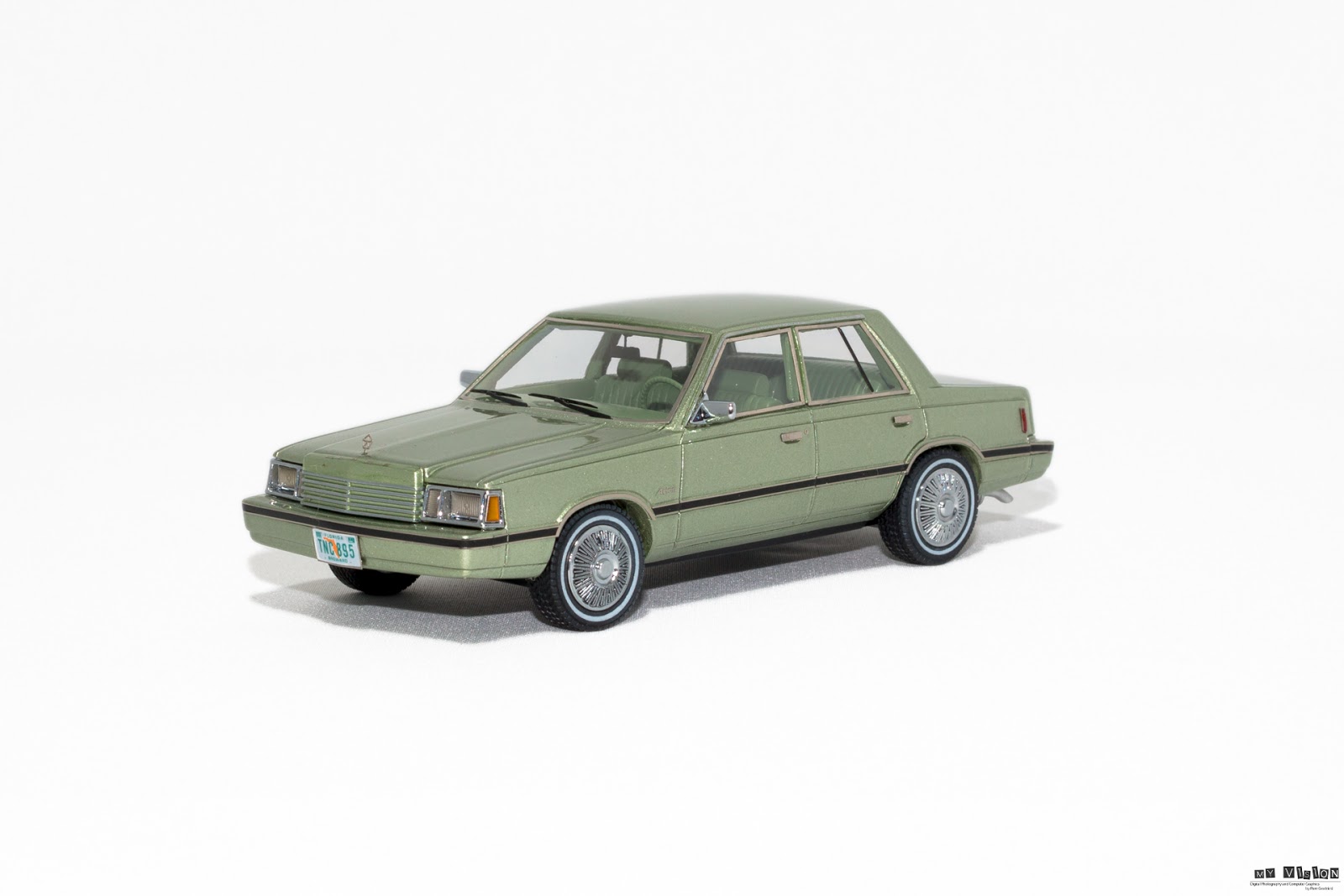
Dodge Aries K-Car

Thursday 16 November 2017
The Plymouth Reliant and Dodge Aries were introduced for model year 1981 as the first "K-cars" manufactured and marketed by the Chrysler Corporation. As rebadged variants, the Reliant and Aries were manufactured in Newark, Delaware, Detroit, Michigan, and Toluca, Mexico — in a single generation.
The Reliant replaced the Plymouth Volaré/Road Runner. The Aries replaced the Dodge Aspen. Though similar in exterior size to a compact car, the Reliant's interior volume gave it a mid-size designation from the EPA. The Aries was sold as the Dart in Mexico.
The Reliant and Aries were selected together as Motor Trend magazine's Car of the Year for 1981 — and sold almost a million Aries and 1.1 million Reliant units over the nine-year run.
As the 1970s ended, Chrysler was facing a grave financial crisis due to poor business decisions, lack of investment in new products during previous years, and external factors outside of their control. Lynn Townsend, chairman from 1962–75, had pursued a hands-off policy of running the company, refusing to spend more than the minimum on new drivetrains or platforms as long as the existing ones continued to sell. Sales of the company's larger cars started dropping after the 1973 OPEC Embargo and an increased amount of company volume consisted of lower profit compact models. Chrysler also had a policy of producing cars regardless of whether a customer ordered them (in contrast to AMC, Ford, and GM who only produced vehicles they received orders for) and soon was left with a backlog of unsold inventory which cost money to store. They had to resort to the money-losing tactic of rebates to get rid of these excess cars. Compounding these difficulties were new Federal emissions and safety regulations during the 1970s which added more to the production costs of each car.
Townsend retired in 1975 and left the reins to John Riccardo, who presided over a slowly-sinking company. The following year, the compact Dodge Aspen/Plymouth Volare debuted as replacements for the dated Dodge Dart/Plymouth Valiant, but were rushed into production and ended up with a major string of quality control problems that led to them being one of the most recalled cars in US history. In 1977, Riccardo petitioned newly elected US president Jimmy Carter for a Federal bailout, but Carter would not consider the idea as long as Chrysler's present management were in charge. In January 1978, Chrysler released the Dodge Omni/Plymouth Horizon, a US adaption of the European Simca Horizon and the first domestic-built FWD subcompacts. But they came out in a year when larger cars were in demand and dealers struggled to move them from lots, costing the hard-pressed company yet more money.
Meanwhile, Ford president Lee Iacocca was fired in April 1978 and three months later, Chrysler offered him the position of company president. By this point, the smallest of the Big Three American automakers was close to collapse, struggling from the unexpected poor sales of the Omni, the fallout from the Aspen recalls, and the decision to discontinue full-sized Dodges and Plymouths in 1978, leaving them without a full-sized car in a year of strong sales for them. Even worse, quality control on Chrysler vehicles had become alarmingly bad since 1976.
Although the K-platform had been designed during 1978, the failing company could not afford by this point to put them into production. Iacocca and Riccardo thus decided to repeat the original 1977 request for government assistance, but since the Carter Administration would not offer any help until the existing management was removed, Riccardo summarily stepped down as chairman and handed Iacocca the job.
During a series of Congressional hearings, Lee Iacocca made his case for a Federal bailout of Chrysler, citing past bailouts of the railroad industry and aerospace company Lockheed-Martin as precedent. He argued that thousands of American jobs would be saved and furthermore that the company had been consciously attempting to build modern, economical cars such as the Omni, but fate had dealt them a bad hand. Iacocca also stated that excessive government regulations were costing needless money.
Congress approved the bailout after Chrysler detailed the plans for their new FWD platform and the first handful of K-cars trickled off the assembly line at Detroit's Jefferson Avenue plant in late 1980.
The Reliant and Aries were downsized replacements for the six-passenger Volare and Aspen, which in turn were modernized version of the original Valiant and Dart compact cars of the 1960s. Based on experience gained with subcompact Omni/Horizon of 1978, the roomier K-cars set out to build a family sized car with a front-wheel drive design powered by a four-cylinder engine. They were offered as 2 and 4 door notchback sedans and wagons and retained six-passenger seating on two bench seats. While the Chevrolet Citation introduced front-wheel drive in the 1980 model year to replace the Nova, its unusual styling and problems with recalls hampered its success. They achieved nearly a million in sales between the two original nameplates before being rebadged and upgraded, not counting the numerous stretched, sporty or minivan derivatives. Ford would not replace its family-sized Fairmont/Granada/LTD with a front-wheel drive design until the 1986 Ford Taurus, while cars like the Chevrolet Cavalier and Ford Tempo would be marketed as upscale compacts rather than family sedans.
After their introduction, the Reliant and Aries were marketed as the "Reliant K" and "Aries K". A "K" badge was also added after the word "Reliant" and "Aries" to the rear of the cars. The Reliant and Aries were Motor Trend magazine's Car of the Year for 1981.
Initial advertisements for the Aries were done in red, white, and blue and emphasized American industry's desire to answer the challenge of Japanese products. Because of how financially strapped that Chrysler was, early promotional shots featured the same car, but with Dodge and Plymouth badges and trim swapped.


Technical data:
- engine: 4 cylinders
- capacity: 2200 cc
- horsepower: 115 HP
- gearbox: 5+1
- top speed: 170 km/h

Dodge 600 Convertible

Monday 23 July 2017
The Dodge 600 is a mid-size car that was built by Dodge. It was introduced in 1982, as a 1983 model, based on the Chrysler E platform and was discontinued after the 1988 model year. It was Chrysler's answer to the GM A-body, whereas the M-body Dodge Diplomat would compete with full-size cars. It replaced the 400. (Dodge 600 coupes and convertibles were, essentially, rebadged 400s.) Like the preceding 400, it was positioned between the Aries and Diplomat.
The 600 was intended to be Dodge's answer to the European sedans of the day. Its numerical name and rear-end styling was designed to evoke thoughts of Mercedes-Benz models, however it fell more in line with North American contemporaries such as the Chevrolet Celebrity, Pontiac 6000 and the Ford Fairmont (the 600 actually resembled the Dodge Mirada more than any European car). It debuted as a four-door sedan, available in two trims: Base and ES ("Euro Sport"). Power was provided by Chrysler's 2.2 L 4-cylinder engine, with the Mitsubishi-built 2.6 L 4-cylinder available as an option.
Sales of the 600 nearly doubled in its second year. This was in large part due to the addition of the former 400's coupe and convertible body styles to the 600's range (which continued to stay on the K platform). Like most midrange-to-upscale K-car derivatives, digital dashboards and the Electronic Voice Alert were options.
Several changes were made to the 600 in 1985. The 600 sedan was moved to a longer wheelbase and the former base and ES trims were dropped, replaced by a new SE trim. This was due in part to the new Lancer, which would have competed directly with the 600 (the 5-speed manual transmission was no longer offered as well, in an attempt to keep competition between the Lancer and 600 to a minimum). The coupe and convertible remained relatively unchanged except for minor trim and interior changes. The only significant advancement was the replacement of the 2.2 L engine's two-barrel Holley electronic feedback carburetor by an electronic throttle-body fuel injection system.
The sedan's base trim returned in 1986, while all 600s were given new, restyled front and rear fascias (the front in particular adopted the now familiar "crosshair" grille, dropping the Mirada-inspired horizontal slats). The 2.6 L engine was replaced by a larger 2.5 L version of the Chrysler 2.2 L.
The phase out of the 600 started in 1987 with the coupe and convertible versions being discontinued in that year. Production of the sedan ended in 1988. The 600 was replaced by the 1988 Dodge Dynasty (badged as a Chrysler in Canada, whereas the Canadian successor is the Dodge Spirit).
There were negotiations to build the car in China after production ended. Hongqi imported a couple of 600s and applied a new rear end and Hongqi badging, intending to sell them as the Hongqi CA750F in China. However, Volkswagen's long-term outlook convinced the Chinese otherwise and Hongqi chose to build the Audi 100 instead, albeit fitted with a locally built version of Chrysler's 2.2-liter inline-four.


Technical data:
- engine: 4 cylinders
- capacity: 2200 cc
- horsepower: 142 HP
- gearbox: 5+1
- top speed: 150 km/h

Dodge Custom Royal Lancer

Monday 26 June 2017
The Dodge Custom Royal is an automobile which was produced by Dodge in the United States for the 1955 through 1959 model years. In each of these years the Custom Royal was the top trim level of the Dodge line, above the mid level Dodge Royal and the base level Dodge Coronet.
The model shown below is a 1957 convertible version. If you have more information on this car, please share.


Technical data:
- engine: V8
- capacity: 5700 cc
- horsepower: 230 HP
- gearbox: 4+1
- top speed: 140 km/h

Dodge Coronet

Thursday 23 March 2017
Coronet is an automobile that was marketed by Dodge as a full-size car in the 1950s, initially the division's highest trim line but, starting in 1955, the lowest trim line. From the 1965 to 1975 model years the name was on intermediate-sized models. A coronet is a small crown consisting of ornaments fixed on a metal ring.
The new Coronet was a twin of the four-door Plymouth Satellite and featured more flowing styling. It was offered only as a sedan and wagon, the related and also restyled Dodge Charger covering the coupe market. Slight alterations of the front grille, headlights, and taillights followed in 1972. Sales of the Coronet were fairly low from this point onwards, with around 80–90,000 produced each year through 1973 (compared with 196,242 as recently as 1968), due both to the fuel crisis and to a proliferation of Dodge and Plymouth models, and the growing effect of overlap with the other Chrysler Corporation brands.


Technical data:
- engine: 6 cylinders
- capacity: 3682 cc
- horsepower: 105 HP
- gearbox: 3+1
- top speed: 140 km/h

Dodge Charger R/T

Sunday 10 July 2016
The Dodge Charger (B-body) is a mid-size automobile that was produced by Dodge from 1966 to 1978, and was based on the Chrysler B platform.
The entire B-body lineup for the 1968 model year was redesigned and the Charger was further differentiated from the Dodge Coronet models. Designer Richard Sias developed a double-diamond coke bottle profile with curves around the front fenders and rear quarter panels. Front and rear end sheet metal was designed by Harvey J. Winn. The rear end featured a "kick up" spoiler appearance, inspired by Group 7 racing vehicles. On the roof, a "flying buttress" was added to give the rear window area a look similar to that of the 1966-67 Pontiac GTO. The Charger retained its full-width hidden headlight grille, but a vacuum operated cover replaced the electric motor rotating headlights. The previous full-width taillights were replaced with dual circular units at the direction of Styling Vice President, Elwood P. Engel. Dual scallops were added to the doors and hood.
Inside, the interior was new with a conventional fixed rear seat replacing the folding bucket seat design. The conventional trunk area included a vinyl mat, rather than the previous model's carpeted cargo area. The center console in the front remained, but there was no center armrest. The tachometer was now optional instead of standard and the electroluminescent gauges disappeared in favor of a conventional design.
The standard engine was the 318 cu in (5.2 L) 2-bbl V8, until it was replaced in mid-year with a 225 cu in (3.7 L) slant-six. The 383-2 and 383-4 remained unchanged. A new high-performance package was added, the R/T ("Road/Track" with no 'and' between Road and Track). The R/T came standard with the previous year's 440 "Magnum" and the 426 Hemi was optional.
In 1968, Chrysler Corporation began an ad campaign featuring a cartoon bee with an engine on its back featuring models called the "Scat Pack". The Coronet R/T, Super Bee, Dart GTS, and Charger R/T received bumble-bee stripes (two thin stripes framing two thick stripes). The stripes were standard on the R/Ts and came in red, white, or black, but could be deleted at no extra cost.
The 1968 model year Charger sales increased to 96,100, including over 17,000 Charger R/Ts.
In 1968, the NASCAR inspired Charger R/T failed to beat the Ford cars (the Ford Torino Talladega and the Mercury Cyclone Spoiler II) on the high-banks oval-tracks. Wind tunnel tests showed the tunneled rear window caused lift and the gaping mouth induced drag. As a result, Dodge made the rear window flush with the rest of the roof and put a 1968 Coronet grille in the front.
The original Charger 500 prototype was a 1968 Charger R/T with a 426 Hemi and automatic transmission. The prototype was painted in B5 Blue with a white stripe, as well as a white interior. The Charger 500 was one of three models introduced in September 1968. Standard engine was the 440 Magnum, but factory literature claims the 426 Hemi was standard. The Charger 500 had the Torqueflite standard and the same equipment standard as the R/T.
A total of 500 Charger 500s were made, of which only 67 had the 426 Hemi engine; 27 with a 4-speed and 40 with an automatic transmission.

Technical data:
- engine: V8
- capacity: 6300 cc
- horsepower: 330 HP
- gearbox: 4+1
- top speed: 210 km/h

Dodge Charger Daytona

Friday 13 May 2016
Dodge, an American automobile brand, produced three separate vehicles with the name Dodge Charger Daytona, all of which were modified Dodge Chargers. The name is taken from Daytona Beach, Florida, which was an early center for auto racing and still hosts the Daytona 500, one of NASCAR's premier events. The first use of the Daytona name on a car was on a version of the Studebaker Lark. The Daytona was the performance model of the compact Lark and it was produced from 1963–1966.This vehicle has also starred in the BlockBuster action film, Fast and Furious 6.
With the failure of the 1969 Dodge Charger 500 on the highbanks of the superspeedways (tracks of a mile, or more in length), the 1969 Dodge Charger Daytona was created. It was intended to be a high-performance, limited-edition version of the Dodge Charger produced in the summer of 1969 for the sole purpose of winning high profile NASCAR races. It won its first race out, the inaugural Talladega 500 in the fall, although it was a rather hollow victory as all of the top names had left the track on Saturday in a boycott of the 1969 Talladega race. Buddy Baker in the #88 Chrysler Engineering Dodge Charger Daytona was the first driver in NASCAR history to break the 200 mph mark on March 24, 1970 at Talladega. The 1969 Dodge Daytona won two races in 1969 and another four in 1970 for a total of 6. Its successor, the 1970 Plymouth Superbird, won 8 races - all in 1970. (In a bit of irony, in 1969 a Daytona won at Talladega, and a Ford Torino Talladega won at Daytona.) These compare with 29 NASCAR victories for the 1969 Ford Torino Talladega, and 8 for the 1969 Mercury Cyclone Spoiler II. The 1969 Dodge Charger 500 managed to win 22 NASCAR races over the 1969 and 1970 seasons; however, all but one of those victories came on the short tracks - several of which were still being run on dirt at the time.
One of the four famous aero-cars, the Dodge Daytona had featured special body modifications that included a 23-inch-tall (584 mm) stabilizer wing on the rear deck, a special sheet-metal "nose cone" that replaced the traditional upright front grille, a flush rear backlight (rear window area), a 'window cap' to cover the original Charger's recessed rear window, specific front fenders and hood that were modeled after the upcoming 1970 Charger, stainless steel A-pillar covers and fender mounted tire clearance/brake cooling scoops. The Daytona was built on the 1969 Charger's R/T trim specifications, meaning that it carried a heavy-duty suspension and brake setup and was equipped with a 440 CID Magnum engine as standard. Of special note to collectors is the optional 426 CID Hemi V8 engine, which only 70 of the 503 Daytonas carried. It had a corporate cousin in the "one year-only" 1970 Plymouth Superbird.
The "Winged Warriors", as they were affectionately known, did not compete for long in NASCAR's top Cup series. Because of their exceptional speed and performance, NASCAR subsequently changed the rule book, effectively banning all five of the Aero Cars from Dodge, Ford, Mercury, and Plymouth from competition by the end of 1970. See also Plymouth Superbird, Ford Torino Talladega and Mercury Cyclone Spoiler II for additional information about the aero cars.
The Dodge Daytona is now a very rare and valuable collectible, with 440-powered Daytonas reaching into six-figure territory and 426 hemi-engined cars passing the $300,000.00 mark. The "Super Charger IV EL", which looked like a roadster prototype spin-off of the Charger Daytona minus the roof and spoiler, is seen as a pimp-mobile in the 1974 film Truck Turner. Actually, it was just an older Charger show car updated with a SuperBird nose.
A car resembling the Daytona appeared in Universal Studio's 2013 action movie Fast & Furious 6. According to the story line of the film it was an ultra-expensive original Hemi Daytona that had been modified into a pro touring super car. It was driven aggressively by the character Domenic Toretto played by Vin Diesel. In truth, the vehicles used in filming were actually regular 1968 to 1970 chargers with nose pieces and spoilers welded on. They used Chevrolet Racing crate motors and Brembo racing brakes to create a versatile stunt car. The car gets heavily damaged at the end of the film.

Technical data:
- engine: V8
- capacity: 7200 cc
- horsepower: 425 HP
- gearbox: 4+1
- top speed: 220 km/h

Dodge Charger

Sunday 8 May 2016
The Dodge Charger is a brand of automobiles marketed by Dodge. The first Charger was a show car in 1964. There have been several different production Chargers, built on three different platforms and sizes. In the U.S., the Charger nameplate has been used on subcompact hatchbacks, full-sized sedans, and personal luxury coupes. The current version is a four-door sedan.
The 1971 model year introduced a new third generation Charger that was characterized by a new split grille and more rounded "fuselage" bodystyle. The interiors were like those of the E-body and were now shared by the Plymouth B-body, the Plymouth Satellite Sebring and Road Runner. The hidden headlights were now optional. A rear spoiler and a "Ramcharger" hood were new options. This hood featured a pop-up scoop mounted above the air cleaner controlled by a vacuum switch under the dash. On Plymouth Road Runners it was called the "Air Grabber" hood, and it was previously used on the Coronet R/T and Super Bee.
Dodge also merged its Coronet and Charger lines. From 1971, all four-door B-bodies were badged as Coronets and all two-door B-bodies as Chargers. Thus for one year only, the Charger Super Bee became part of the Charger lineup. From 1971 to 1974, Charger models used the Coronet's VIN prefix of "W".
The Dodge Super Bee made the move from the Coronet line to the Charger line for 1971 only, after which this model was discontinued. Several other models were carried over from 1970, including the 500, R/T, and SE. Sales of the R/T declined due in part to higher insurance costs. A total of 63 Hemi versions were built, and 2,659 were built with other engines that year. Increasing insurance rates, combined with higher gasoline prices, reduced sales of most muscle cars and 1971 was the last year of availability for the 426 Hemi "Elephant engine" in any car. The 1971 model year was the last for the 440 Six-Pack engine (although some early Dodge literature (August 1971 press) stated that this engine was available for 1972. However, a few factory installed six-pack Chargers and 6BBl Road Runners were built early in the production run). In the Super Bee's final year, the 340 became a $44 option over the standard, low-compression 383 .
The "Hi-Impact" colors were discontinued after the 1971 model year; with a 1971-only "Citron Yella".
The 1972 Charger introduced a new "Rallye" option to replace the R/T version. The SE was differentiated from other 1972 Chargers by a unique formal roof treatment and hidden headlights. The 383 engine was replaced with a lower compression 4-barrel 400, while the 440 engine were still available, rated at net 280 hp (209 kW; 284 PS) rating instead of the previous 350 hp (261 kW; 355 PS) gross values. The ratings went down as the net horsepower measure was more realistic. Also beginning in 1972, all engines featured hardened valve seats to permit the use of regular leaded or unleaded gasoline rather than leaded premium fuel as in past years due to tighter emissions regulations. Though the 440+6 (designating a triple 2-barrel carb setup and 310 bhp (231 kW; 314 PS) was listed in the early 1972 sales literature, it was found in the August 1971 testing that this engine would not meet the new and more stringent 1972 emissions laws. The low-compression 4-barrel 440 Magnum 280 hp (209 kW; 284 PS) with a 4-barrel carburetor became the top engine, and the optional Pistol-Grip 4-speed Hurst manual shifter could be coupled to the 340, 400, and 440 Magnum engines. The Ramcharger hood scoop was discontinued, as well as elimination of optional lower geared performance rear axle ratios and extra heavy duty suspensions. It was also the final year for the Dana 60 differential, and was available only in combination with the 440/4 speed, heavy duty suspension, and the 3.54:1 rear axle ratio.
The only remaining "Hi-Impact" color choices were "Hemi Orange" (EV2) and "Top Banana" (FY1), the latter was available under different names through 1974.
For the 1973 model year, Chargers received new sheet metal (though at first glance only the rear roof "C-Pillars" looked different) and were in fact longer, wider, and slightly taller than the 1971-72 cars. Also new were vertically slatted taillights and new grilles. Hidden headlights were dropped, even as an option. The 318 was still standard, with the 340 (available only on the Rallye), 360 (2-barrel only), 400 (low power 2-barrel/single exhaust and high performance 4-barrel/dual exhaust) and 440 remaining as options. The SE models had a new roof treatment that had a "triple opera window" surrounded by a canopy-style vinyl roof. All other models had a new quarter window treatment, discontinuing its AMC Gremlin-style window in favor of a more conventional design. Total sales this year were around 108,000 units, the highest ever for the 1971-74 Charger generation, though more than 60 percent of the cars had the non-high performance engines. The 1973 Chargers, and all Chrysler products, were equipped with 5 mph bumpers, front and rear.
The 1974 model year saw only minor changes that included new color choices, a softer grain pattern on interior surfaces, and a slight increase in the size of the rubber bumper tips. The 340 option was dropped and the 360 4-bbl replaced the 340 as the small block performance engine. All other engine options remained the same. Several performance rear end ratios, including a 3.23 "Sure Grip" rear end were still available. A four speed transmission was still an option except with the 440 engine. Emphasis now turned to luxury instead of performance with higher sales for the SE model. The Charger, was no longer considered a performance model as it turned into a personal luxury car. The muscle car era came to a close, and the 1974 Dodge Charger would be the final year. The 1974 also came with a 360 cu in (5.9 L) 2-bbl V8, with a K in the fifth symbol in the vehicle identification number.

Technical data:
- engine: V8
- capacity: 5900 cc
- horsepower: 195 HP
- gearbox: 4+1
- top speed: 190 km/h