Pokazywanie postów oznaczonych etykietą Renault. Pokaż wszystkie posty

Renault 18 GTX II

Monday 10 May 2021   

The Renault 18 is a large family car produced by French manufacturer Renault between 1978 and 1989, with South American production continuing until 1994. It formed the basis for the closely related Renault Fuego Coupé, with which it shared its floorpan and drivetrain, but with the Fuego initially using the negative offset type front suspension from the larger Renault 20/30, which became standardized across the 18 range from the 1983 model year onwards.

The Renault 18 was intended as a replacement for the Renault 12, which, having been in production since 1969, was beginning to show its age by the late 1970s, though the 12 was kept in production alongside the 18 until 1980. Unlike the earlier car, the 18 was designed quickly; the time between its initial conception and its actual launch date was only eighteen months, primarily due to the fact that the 18 was based upon the 12's underpinnings. Production peaked early: 1979 was the R18's biggest year, after which sales began a gradual decline. Originally, the 1.4 was the most popular model, but this soon changed to the 1.6. By 1986 the largest, 2-liter engine represented the biggest portion of production.

Although Renault made numerous forays into international markets in countries such as Argentina with the 12, their first true "world car" was their 18, hence the slogan Meeting International Requirements, which (as well as in France) would later be produced in ten other countries and four continents around the world. In 1981, the Renault 18 was selected by India's massive public sector car manufacturing project Maruti Udyog to be built there at a rate of 100,000 cars per year - including a pickup truck version meant to compete with small Japanese trucks. However, after closer review and at the direction of Rajiv Gandhi (who had always wanted to build a small people's car) it was determined that the economics did not make sense and that a smaller, cheaper car would be the better option. Maruti instead linked up with Japanese Suzuki to build the subcompact Alto under license.

The Renault 18 went into production at Renault's Flins factory in France in December 1977. It was presented at the Geneva Salon in March 1978, with marketing and sales starting the following month.

nitially, the R18 was only available as a four-door saloon, in TL, GTL, TS and GTS trim variations. The TL and GTL were powered by the 1397 cc Renault Cléon petrol engine (which was developed from the 1289 cc engine from the Renault 12), which produced 64 PS (47 kW; 63 hp). Both models had a four-speed gearbox. The TS and GTS were powered by the 1647 cc A-Type engine (which was the same as used in the Renault 17 TS) but without the fuel injection, which lowered the output to 79 PS (58 kW; 78 hp). The TS had a four-speed manual gearbox, while the GTS had a 5-speed manual gearbox, with optional 3-speed electronic automatic transmission available for both models. The automatic versions of the TS and GTS models were called the TS Automatic and GTS Automatic to distinguish them from their manual transmission counterparts. Assembly of the Dacia 18 began in Romania in 1978, but in a very small number (less than 100 ), mainly for the state. It was intended as a replacement for DACIA 1300, a model derived and based on Renault 12, but the licence and production between Dacia and Renault ended in 1979, so it was dropped. It was also presented at TIB'78, TIB meaning "Târgul Internațional București" (International Bucharest Fair).

The 18 was Renault's first car to use the 1.4 L Cléon engine in the medium-size car sector. The Renault 18 also used three-stud wheels (similar to those of the Citroën 2CV), rather than the four- or five-stud wheels common on most of its contemporaries. In 1980 Turbo and Diesel R18 models came fitted with four-stud wheels (necessitated by using suspension parts and wheels from the larger R20 and Fuego), with all versions using four-stud wheels from the 1983 facelift onwards.


Technical data:
- engine: S4
- capacity: 2000 cc
- horsepower: 104 HP
- gearbox: 4+1
- top speed: 150 km/h

Renault Estafette

Wednesday 27 January 2016
The Renault Estafette is a small front-wheel drive van, first introduced in 1959, initially using the water-cooled Renault Ventoux engine, then later the Cléon-Fonte engine in a range of body styles.
Following the launch of the Estafette, Renault became the only auto-maker in the world to simultaneously produce and sell vehicles with all three of the drive train configurations commonly used, with the front engined front wheel drive Estafette, along with various rear engined rear wheel drive cars such as the Dauphine and the front engined rear wheel drive Frégate and the ageing Dauphinoise.
In the summer of 1944 the French Ministry of Industrial Production set out a prescriptive plan to make the most of scarce resources for the post war motor industry. It was headed by Paul-Marie Pons and so it was known as the Plan Pons. Under the Plan Pons, Peugeot, Renault and Chenard & Walcker were restricted to making vans for 1000–1400 kg while Citroen was to make small trucks for 2 and 3.5 tonnes. However, Pierre Jules Boulanger at Citroen was not going to be dictated to and went ahead with the design of the Citroën H Van, which launched in 1947. This odd-looking corrugated-bodied, angular design featured front wheel drive and so allowed for an exceptionally low loading floor. It was an immediate success.
Renault obeyed the Plan Pons instructions and designed the 206 E1 following general pre-war design ideas. It had a fixed chassis onto which the van body was bolted and the body was made by fitting metal panels to a wooden frame. This old-fashioned method paid off in terms of the time it took to build and overall production costs, because at the time stamped body panels were relatively expensive and it also saved weight. In this period of material shortages Renault did the best they could and the 1000 kg as it became known was a success, but not on the scale of Citroen's H Series that was selling to small businesses such as shop keepers and tradesmen. It was for this reason that Renault decided to fill the gap between the 300 kg Renault Juvaquatre and the 1000 kg 206 E1.
It was clear that they needed a front-wheel-drive van, but the company had just signed up to a policy of rear-engined, rear-drive models with the 4cv and the Dauphine, then under development for 1957. The only example of a rear-engined van was the VW Type 2, and it did not offer load-space or a low floor to rival the Citroen. Reluctantly Fernand Picard, the designer of the 4cv, agreed to give the go-ahead to the team headed by Guy Grosset-Grange to try something new. As a question of production logic, they had to use existing Renault parts, and that meant the new engine being developed for the Dauphine, but adapting it for a front drive van was not simply a matter of moving it and turning it around, and therefore they had to match it to a new gearbox, which gave them the opportunity to choose gear ratios to suit the van's needs.
They also worried if the 845 cc engine would cope with a 600 kg payload, and they doubted it would have enough power or durability, until they heard of the German Gutbrod Atlas that was carrying 1000 kg using a tiny 622 cc engine. They brought one to France, and used it as a test bed for the 845 cc engine and were soon satisfied that it would work well. And so began over 2 million kilometres of testing.
Launched in June 1959, the new van was to be called the Estafette from the Italian Staffetta, meaning Courier. At launch, the engine, although mounted near the front of the Estafette, was of the same size and output as that fitted to the recently introduced Renault Dauphine. The Estafette's emphasis was always on economy and practicality rather than on power or heavy-duty performance.
It was introduced in four body types; the normal van with the rear door in three sections, in a variation on the stable door style. The upper part with the window hinged upwards, while the lower part was divided into two halves, opening to the left and to the right. A sliding door on the pavement side of the load space was also normally fitted, as was a sliding driver's door. There was a high roof version with translucent plastic roof that on its lower part was left unpainted and the top was normally white (though later models could be fully painted). The pickup version had a tubular frame to support the canopy which could easily be pushed forward and stored behind the cab which was closed off. The tailgate of this model could be used as a convenient loading ramp or be removed altogether. A minibus was also introduced seating eight passengers and the driver. Originally the Estafette was available only in four colours from the factory; grey, blue, yellow or orange.
The Estafette gave all it had promised, with its low floor and wide rear opening; the high roofed version were especially popular with companies having to load bulky items because although the 0.8cu metre increase in capacity didn't sound a lot, it did allow a man to stand inside to help load. And it was very popular as a mobile shop, which at markets became as typically French as the ice cream van is English.
In 1961 came the Alouette version which was a simpler version of the minibus with removable seats that could convert it into a camper van and was indeed popular with French conversion companies. Finally a chassis-cab version was introduced onto which innumerable bodies could be fitted.
In May 1962 the 800 kg (1,764 lb) rated Estafette was the first vehicle to receive Renault's newly developed "Sierra" series water-cooled four-cylinder 1,108 cc five-bearing engine, which was destined to appear in a passenger car a month later with the launch, in June 1962, of the Renault 8.
In 1968 a series of 70 vans were issued to the police at the winter Olympics held in Grenoble, and this led to a long term contract, but Renault's biggest customer for the Estafette was PTT, the French telephone company. In 1968 it gained the 1,289 cc engine later seen in the Renault 12 to give a full 1000 kg capacity. In 1973 the grille was updated, with a plainer modern look. The Estafette continued in production until 1980 when it was replaced by the Trafic, having sold over 500,000 units.
In Romania, a version of the Estafette was produced for the Romanian Post between 1975 and 1978, by Automobile Dacia, in only 642 units (842 by other sources).

Technical data:
- engine: 4 cylinders
- capacity: 1289 cc
- horsepower: 50 HP
- gearbox: 4+1
- top speed: 100 km/h

Renault Alpine A310

Monday 18 January 2016
The Alpine A310 is a sports car built by French manufacturer Alpine, from 1971 to 1984.
Dieppe-based Alpine, once an independent company specialising in faster Renaults, later a Renault subsidiary, established a fine competition history with the Alpine A110 winning the 1973 Monte Carlo Rally and World Rally Championship. The successor was the Alpine A310, initially powered by tuned 17TS/Gordini four-cylinder engine, still rear-mounted. The maximum power reaches 127 PS (93 kW; 125 hp), thanks to the use of two twin-barrel 45 DCOE Weber carburetors.
The first model of the A310, built 1971-1976, was a car with a four-cylinder engine and six frontlights. In 1976 the A310 was restyled by Robert Opron and fitted with the more powerful and newly developed 90-degree 2,664 cc V6 PRV engine, as used in some Renaults, Volvos and Peugeots. The car was first shown at the 1971 Geneva Motor Show. The prototype A310 had louvres across the rear windscreen; these were not carried over to the production model. Early models had a NACA duct mounted near the window atop the left front fender, later four-cylinder cars received two, mounted closer to the front of the car. The A310 was labor intensive, having been developed for small-scale artisanal production - a car took 130 hours to build from start to finish. The front axle also came in for some criticism, although in 1974 the balljoint mountings were replaced by rubber/steel bushings (silent-blocs) which somewhat improved the longevity. While many bits of the A310 came from the Renault parts shelf as expected, others are more surprising - the steering rack is from the Peugeot 504, while the turn signals are Simca 1301 units.
The basis of the A310 was a hefty tubular steel backbone chassis, clothed in a fiberglass shell. As for the previous A110 the entire body was molded in a single piece. Like the ill-fated De Lorean DMC-12, which used the same PRV powertrain, the engine was mounted longitudinally in the rear, driving forward to the wheels through a manual five-speed gearbox. The driving position was low and sporty, although the front wheelwells encroached on the occupants' feet, pointing them towards the centre of the car. The later V6 received a black plastic rear spoiler as well, useful for keeping the tail planted but somewhat marring to purity of the original's lines. With 150 PS (110 kW) on tap, the A310 PRV V6 was Renault's performance flagship capable of 220 km/h (137 mph) and acceptable acceleration. The tail-heavy weight distribution gave handling characteristics similar to the contemporary Porsche 911. Beginning with model year 1981 (in late 1980), the rear suspension was shared with the mid-engined Renault 5 Turbo. Rather than the previous three-lug wheels, the A310 also received the alloys used for the 5 Turbo, albeit without the painted elements.
In the later models (1983-1984) of the A310 a "Pack GT" which was inspired from the Group 4 A310 racing cars would be developed, it gained wheel arches and larger spoilers front and rear. A few Alpine A310 V6 Pack GT Kit Boulogne were built (27 examples), here the PRV V6 was bored out to 2.9 litres and was then further modified by Alpine, fitted with triple Weber 42DCNF carburetors that pushed power to 193 PS (142 kW).

Technical data:
- engine: V6
- capacity: 2664 cc
- horsepower: 150 HP
- gearbox: 5+1
- top speed: 200 km/h

Renault 4L

Friday 14 August 2015
The Renault 4, also known as the 4L (pronounced "Quatrelle"), is a hatchback economy car produced by the French automaker Renault between 1961 and 1992. It was the first front-wheel drive family car produced by Renault.
The car was launched at a time when several decades of economic stagnation were giving way to growing prosperity and surging car ownership in France. The first million cars were produced by 1 February 1966, less than four and a half years after launch; eventually over eight million were built, making the Renault 4 a commercial success because of the timing of its introduction and the merits of its design. It was exceptionally spacious for its size, and although originally marketed as a small estate car, it is now regarded as the first mass-production hatchback car.
The Renault 4 was Renault's response to the 1948 Citroën 2CV. Renault was able to review the advantages and disadvantages of the 2CV design and come up with a larger, more urban vehicle. In early 1956, Renault Chairman Pierre Dreyfus launched this new project: designing a new model to replace the rear engined 4CV that would become an everyman's car, capable of satisfying the needs of most consumers. It would be a family car, a woman's car, a farmer's car, or a city car.
Renault launched the Renault 3 and the Renault 4 simultaneously in July 1961. The cars shared the same body and most mechanical components, but the R3 was powered by a 603 cc version of the engine while the R4 featured a 747 cc engine. This placed the R3 in the 3CV taxation class while the R4 was in the 4CV class. Actual maximum power output was claimed by Renault as 22.5 hp for the R3, and 26.5 or 32 hp for the R4, depending on price level and the type of carburettor fitted. Initially the base versions of the R3 and R4 came with a thick C-pillar behind each of the rear doors. Quarter glass was a 400 francs option for the basic R4. The extra visibility increased the weight of the vehicle, but these windows soon became standard for all R4s.
The R3 and R4 were targeted at the Citroen 2CV that employed soft springs and long wheel travel to absorb bumps on poorly maintained roads. The Renault 3 & 4 applied the same approach and two models appeared at the Paris Motor Show in 1961 on a specialized demonstration display that incorporated an irregular rolling road. Visitors could sit inside car, which remained undisturbed while the suspension absorbed the erratic bumps of the rolling road. In 1962, Renault employed the same display at the Turin Motor Show.
The basic version of the R3 was priced 40 francs below the lowest priced version of the Citroen 2CV in 1961 and featured painted bumpers and grill, a simplified instrument panel, a single sun visor, no windshield washer, and no interior door panels. This trim was also offered in the more powerful R4. The R4L with six side windows, chrome coloured bumper and grill, as well as a less spartan interior cost 400 francs (roughly 8%) more than the R4 with its four side windows. Similar as the Renault 4CV “Service” in 1953, customers shunned the basic model and in October 1962, the Renault R3 was discontinued, along with the most basic version of the Renault 4.
A "super" version (branded "de luxe" in some export markets) with opening rear quarter-light windows and extra trim was also offered. The de luxe and super versions of the R4L received a version of the engine from the Renault Dauphine giving them a four-cylinder engine capacity of 845 cc. After the withdrawal of the 603 cc engined R3, the 747 cc R4 model continued to be listed with an entry level recommended retail price, but the slightly larger-engined L versions were more popular. By 1965, Renault had removed the extra "R" from their model names: the Renault R4L had become the Renault 4L.

Technical data:
- engine: 4 cylinders
- capacity: 747 cc
- horsepower: 32 HP
- gearbox: 4+1
- top speed: 110 km/h

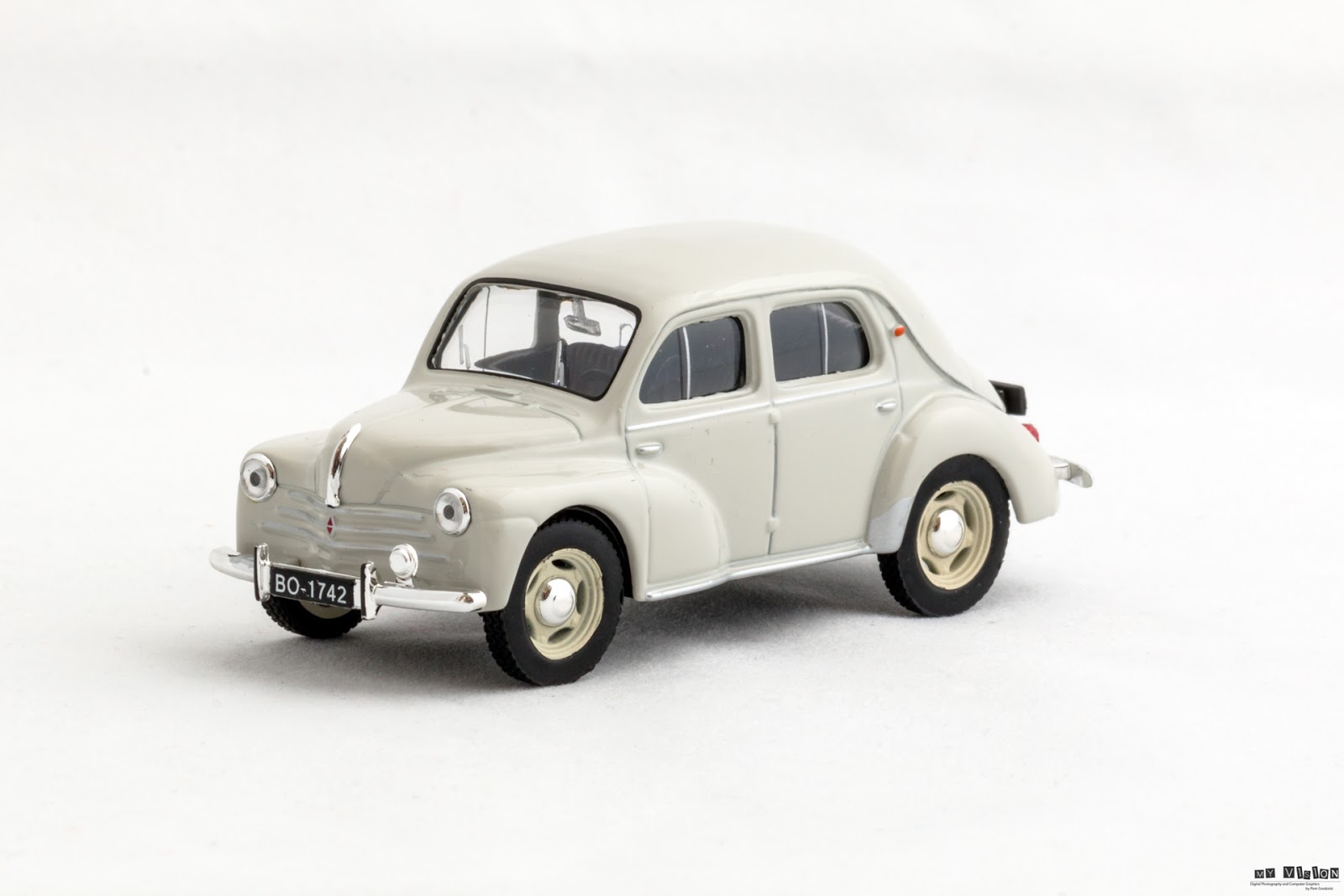
Renault 4CV

Tuesday 11 August 2015
The Renault 4CV (French: "quatre chevaux" [kat ʃə.vo]) is a rear-engined, rear wheel drive, four-door economy car manufactured and marketed by the French manufacturer Renault from August 1947 through July 1961. As the first French car to sell over a million units, the 4CV was superseded by the Dauphine.
The 4CV was of monocoque construction,[ 3.6 m (11 ft 10 in) in length with front suicide doors and using Renault's Ventoux engine in a rear-engine, rear-wheel drive layout.
CV is the abbreviation of cheval-vapeur, the French equivalent to "horsepower" as a unit of power. The name 4CV refers to the car's tax horsepower.
In 1996, Renault presented a concept car — the Renault Fiftie — to celebrate the 50th anniversary of the 4CV's début. It was a two-door, mid-engine design with styling similar to the 4CV.
A variant of the 4CV was the Renault Beach Wagon,also known as the Renault Jolly. 50 of these were built by Ghia in 1961 using consecutively serial numbered 4CV's; approximately a dozen are estimated to exist today.
The 4CV was originally conceived and designed covertly by Renault engineers during the World War II German occupation of France, when the manufacturer was under strict orders to design and produce only commercial and military vehicles. Between 1941 and 1944 Renault was placed under the Technical Directorship of a francophile engineer, Wilhelm von Urach (de; between 1927 and 1940 employed by Daimler Benz) who failed to notice the small car project emerging on his watch. A design team led by the company's Technical Director Fernand Picard, recently returned from Renault's aero-engine division to the auto business and Charles-Edmond Serre, who had been with Renault for longer than virtually anyone else, envisioned a small, economical car suitable for the period of austerity expected after the war. This was in contrast to Louis Renault himself who in 1940 believed that after the war Renault would need to concentrate on its traditional mid-range cars. Jean-Auguste Riolfo, head of the test department, was made aware of the project from an early stage as were several other heads of department. In May 1941 Louis Renault himself burst into an office to find Serre and Picard studying a mock-up for the car's engine.[5] By the end of an uncomfortable ad hoc meeting Renault's approval for the project, now accorded the code "106E", was provided. However, because the Germans had forbidden work on any new passenger car models, the 4CV development was defined, if at all, as a low priority spin-off from a project to develop a new engine for a post-war return of the company's 1930s small car, the Juvaquatre: departmental bosses installed by the Germans were definitely not to be trusted in respect of "Project 106E", while von Urach, their overlord, always managed to turn a blind eye to the whole business.

Technical data:
- engine: 4 cylinders
- capacity: 748 cc
- horsepower: 25 HP
- gearbox: 4+1
- top speed: 110 km/h

Renault 16

Thursday 13 March 2014
This is a standard version of the vehicle described here.


Technical data:
- engine: 4 cylinders
- capacity: 1647 cc
- horsepower: 80 HP
- gearbox: 5+1
- top speed: 165 km/h

Renault 21 Nevada

Friday 14 June 2013
The Renault 21 is a large family car produced by French automaker Renault between 1986 and 1994. It was also sold in North America initially through American Motors dealers as the Renault Medallion and later through Jeep-Eagle dealers the Eagle Medallion. A total of 2,096,000 units were produced.[citation needed]
The Renault 21 sedan was launched in early 1986 as the successor to the successful Renault 18, and this was followed a few months later by the seven-seater station wagon, the R21 Nevada, marketed as the Savanna in the United Kingdom.
Unusually, the Renault 21 was offered with disparate engine configurations. The 1.7-litre version featured an 'east-west' (transversely) mounted engine, but Renault had no gearbox suitable for a more powerful transverse engine: accordingly, faster versions featured longitudinally mounted (north south) engines. The two versions featured (barely perceptibly) different wheel bases: the engines were all relatively compact four-cylinder units and the engine bay was large enough to accept either configuration without reducing passenger space. However, at a time when production technologies were relatively inflexible, the need to assemble differently configured engine bays on a single production line, along with the supplementary inventory requirements imposed both on Renault and on the dealership network, did compromise the Renault 21's profitability.
In 1986, the R21 was launched. It had a razor-like design, which was different from contemporary cars of the era, e.g. the Ford Sierra (with its "jelly mould" design) and the Opel Ascona (with its J-Car design).
The car was revamped considerably in 1989, both technically and aesthetically - the new sleeker outward appearance was similar to the also recently revamped Renault 25, and a liftback body style was also added to the range (which soon became more popular than the sedan in France) along with a sporty 2.0 L Turbo version. The TXi 2.0l 12v and 2.0l turbo was also available with the four-wheel-drive Quadra transmission, and was capable of 227 km/h (141 mph).
The Renault 21 liftback and sedan petrol-fueled models ceased production in early 1994 on the launch of the all-new Laguna liftback, but the diesels and the Nevada (Savanna in the UK) remained on the market until their replacement Laguna variants were launched (late 1994 for the diesels and late 1995 for the Nevada (Savanna)).


Technical data:
- engine: 4 cylinders
- capacity: 2165 cc
- horsepower: 108 HP
- gearbox: 5+1
- top speed: 192 km/h