Pokazywanie postów oznaczonych etykietą Nissan. Pokaż wszystkie posty

Nissan Silvia ZSE

Saturday 9 July 2015
The Nissan Silvia is the name given to the company's long-running line of sport coupes based on the Nissan S platform. Although recent models have shared this chassis with other vehicles produced by Nissan (most notably the European 200SX and North American 240SX in the S13 and S14 generations, and 180SX in the Japanese market), the name Silvia is not interchangeable with the chassis codes.
This iteration of the Silvia (sold in United States and Canada as the Datsun 200SX and in Mexico as the Datsun Sakura (Japanese for cherry blossom)), available as a 2-door hardtop coupe and a new bodystyle 3-door hatchback. The Japanese market version of the hatchback was called the Gazelle and was exclusive to Nissan Bluebird Store locations sold alongside the Fairlady Z, while the coupe bodystyle Silvia remained exclusive to Nissan Prince Store locations alongside the Skyline. Its sharp-edged styling was shared with the new Nissan Leopard sedan and coupe, also exclusive to Nissan Bluebird Store.
This generation Silvia was uniquely progressive in that it was originally intended to feature a rotary engine, designed and built by Nissan. The resulting unit was fairly unreliable, and forestalled production. Coincidentally, it shared a chassis code with the Mazda Cosmo, the first Japanese production car to feature a rotary engine. The chassis was no longer shared with the B-series Nissan Sunny, and was upgraded to the larger A-series Nissan Stanza platform.
The car was redesigned shortly after it was released and the stillborn Wankel power plant was replaced by a line of conventional piston engines based on the new Z-series engine. These included the Z20 and the turbocharged and fuel-injected Z18ET, although the latter of the two was only available to the Japanese domestic market. In USA/Canada the 200SX had the Z20E with H165 rear axle from 1979 to 1981. From 1982 to 1983, it had a Z22E engine with H190 rear axle. Vehicles with engines under 2000cc are still considered "compact" vehicles under Japanese regulations regarding exterior dimensions, however, larger engine displacement incurred a higher road tax bill annually.

Technical data:
- engine: 4 cylinders
- capacity: 2000 cc
- horsepower: 120 HP
- gearbox: 5+1
- top speed: 180 km/h

Nissan Prince Skyline Coupe

Tuesday 11 June 2013
The Nissan Skyline is a line of compact cars, sports cars and compact executive cars originally produced by the Prince Motor Company starting in
1955, and then by Nissan after the two companies merged in 1966. After the merger, the Skyline and its larger counterpart, the Nissan Gloria, were sold in Japan at dealership sales channels called Nissan Prince Shop.
Unfortunatelly there is not nuch information on this model available in Languages other than Japanese. If anyone has any info, please share.


Technical data:
- engine: 4 cylinders
- capacity: 1962 cc
- horsepower: 96 HP
- gearbox: 4+1
- top speed: 155 km/h

Nissan Skyline 2000 GT

Friday 29 June 2012
The Nissan Skyline (スカイライン in Japanese) is a line of compact cars and compact executive cars originally produced by the Prince Motor Company starting in 1955, and then by Nissan after the two companies merged in 1966. After the merger, the Skyline and its larger counterpart, the Nissan Gloria, were sold in Japan at dealership sales channels called Nissan Prince Shop.
It is currently available in either coupé, or sedan body styles, and are most commonly known by their round brake lights, with the station wagon bodystyle being dropped in 1989 with the introduction of the R32 platform.
Iterations R30 to R34 of the Skyline are still popular tuner cars for Japanese car enthusiasts from the 1980s to today, especially with available features such as straight-6 engines, turbochargers, and the high-performance GT-R trim. While not distributed in the United States, the Skyline's prominence in video games, movies and magazines resulted in many such cars being imported there from 1999 to late 2005, after Motorex petitioned the National Highway Traffic Safety Administration to allow 1990–1999 GT-Rs and GTSs to be imported, at the condition that they were modified to meet United States Federal Motor Vehicle Safety Standards.
The 11th-generation Skyline (V35) was another major turning point for the nameplate, as it dropped some of the Skyline's trademark characteristics such as the straight-6 engine and turbocharging, eventually separated the GT-R into its own line, and moved to V6-engined era, this decision which extended to all later Skylines. Nissan decided to retain the Skyline for the luxury-sport market, while its platform-mate, the 350Z, revived the Z line of pure sports cars. The V35 was the first Skyline made for export to North America, being sold under Nissan's luxury marque Infiniti as the G35. The Skyline (V36/J50) is sold in Europe, North America, South Korea, Taiwan, and the Middle East as the Infiniti G37.
April 11, 2010 saw a world record for the biggest ever Nissan Skyline meet and the most ever officially recognized on a track in the Guinness Book of World Records. This took place at Silverstone, United Kingdom at the ISTS event.
In 1971, the KGC10 2000GT-X received a 2.0 L (1998 cc) L20 I6 engine instead of a Prince G-7 engine. The chassis was already designed to receive a straight six, to avoid the S54 extension problem. 120 hp (78 kW) was available from this new engine, in March 1972 Nissan introduced 4 Door Sedan GT-X.
The following year, the GC10 2000GT received a 2.0 L (1998 cc) L20 I6 engine like the Nissan Cedric instead of a Prince G-7 engine. The chassis was already designed to receive a straight six, to avoid the S54 extension problem. 105 hp (78 kW) was available from this new engine, in 1970 Nissan production Skyline 2000GT Automatic, in October 1970 Nissan introduced 2 Door Coupe.

Technical data:
- engine: 6 cylinders
- capacity: 2000 cc
- horsepower: 145 HP
- gearbox: 4+1
- top speed: 190 km/h

Nissan Skyline GTR33

Thursday 21 June 2012
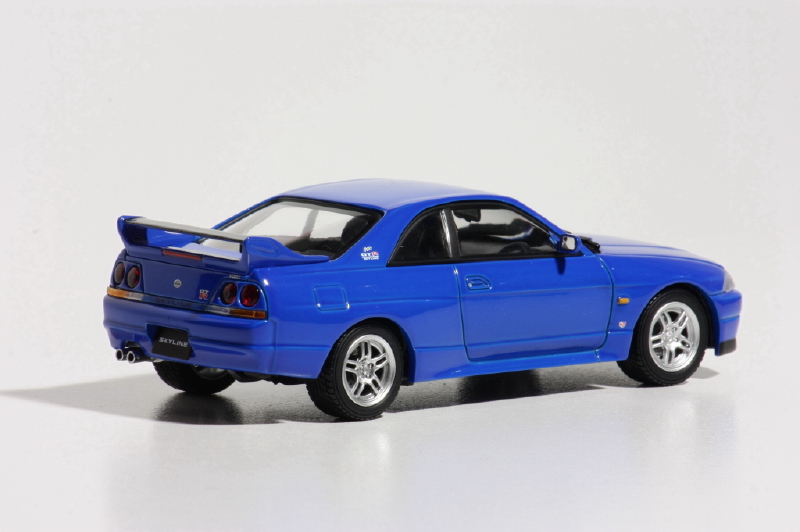
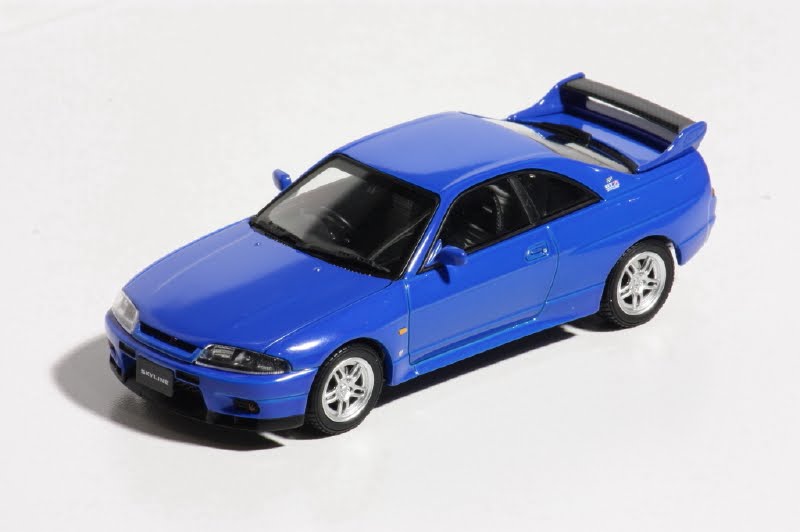
The E-BCNR33 (R33) was developed in 1995 as a successor to the venerable R32 model. The engine in the R33 was nearly identical to the R32. It used the same turbochargers and the same specification for the manual gearbox, although the syncros were made to be stronger. The engine corrected the R32's weak oil pump drive collar, which tended to fail in higher power applications, with a wider collar. The base model R33 GT-R weighs 1,540 kg (3,400 lb).
The R33 GT-R launched in January 1995 with the base model GT-R and the V-spec model. The V-spec model weighed in 10 kg (22 lb) heavier, and had sportier suspension resulting in lower ground clearance. The V-spec also featured the newer ATTESA E-TS Pro all wheel drive system, which included an Active Limited Slip differential. The V-spec model also included a four wheel independent channel anti-lock braking system.
At the same time as the release of the R33 GT-R and GT-R V-spec, Nissan released the R33 GT-R V-spec N1 model. Changes made in the R33 N1 are similar to those in the R32 N1. The car was made lighter by removing the ABS, air conditioning, sound system, rear wiper and trunk carpet. The R33 GT-R V-spec N1 received the slightly revised R33 N1 engine.
A special edition R33 was released on November 3, 1997 called the 400R, with R standing for Racing. Overall development and planning was by NISMO (Nissan Motorsports International). But, its bored and stroked RB26DETT engine, the RBX-GT2, was engineered and produced by REINIK (later renamed REIMAX – "REINIK to the MAX"). The engine featured 77.7 mm stroke crankshaft (73.7 mm stock), forged 87 mm pistons (86 mm cast stock), upgraded rods, polished ports, high lift camshafts, upgraded oil system, larger exhaust manifolds and higher output turbochargers. NISMO produced an upgraded exhaust, a twin-plate clutch, and intercooler system. Nismo brake pads were fitted to the car. 400R exclusive aerodynamic updates were also added, such as wider fenders, side skirts, a new rear bumper, a new front bumper with bigger air scoops, and a redesigned bonnet and rear spoiler made of carbon fiber. The 400R was also fitted with 18x10 Nismo LM-GT1s. The car developed 300 kW (400 hp) and 347 lb·ft (470 N·m), which allowed a top speed of over 186 mph (300 km/h), and enabled it to reach 0–97 km/h in 4.0 seconds. 370 kW (500 hp) is easily achieved with a higher boost setting. NISMO had originally planned to produce 100 units of the 400R, however only 44 units were made before production of the R33 ended in 1998.

Technical data:
- engine: 6 cylinders
- capacity: 2600 cc
- horsepower: 500 HP
- gearbox: 5+1
- top speed: 300 km/h

Nissan Skyline GT R34

Friday 30 March 2012
In May 1998, after sales of the Nissan Skyline plummeted from the release of the R33 chassis the EN34, HR34, ER34 and BNR34 addressed many of the concerns over the change from the R33, with more emphasis on sportiness, and marked the introduction of the more fuel-efficient and environmentally-friendly RB25DET NEO engine. Also the front end was re-arranged from the R33 unattractive front end and was aimed more towards the R32 style to draw people back into the "skyline world" . The RB20E engine was discontinued in the R34 base model (GT), and the RB20DE, after last being used in the R32 Skyline, was reintroduced in updated NEO guise. The R34 GT powered by the RB20DE NEO, coupled with a 5-speed gearbox, became the most fuel-efficient straight- 6 Skyline to date (of any shape). Carlos Ghosn stated on the release date of the Nissan Skyline R34 that " We hope to win people back with the old school design based around the R32 shell, due to the initial complaints corresponded with the R33 chasis and body" The 5-speed automatic transmission available on some models in the previous two shapes were discontinued. In its place, Nissan produced a 4-speed Tiptronic transmission for all of the automatic versions (Except the base 2.0L, which has a standard 5 speed gearbox). Only the GT-T coupe variant was sold in New Zealand from 2000 and it was the only country besides Japan that sold the R34 GT-T model Skylines new. The GT-T models were rebadged as Infiniti G25t for export markets. The Nissan Skyline rivals are the Toyota Supra and the Mazda RX-7.

Engine: 6L
Capacity: 2500 cc
Power: 280 HP
Gearbox: 5+1
Top Speed: 260 km/h

Nissan Skyline GT R32

Friday 30 March 2012
The R32 Skyline debuted in May 1989. It was available as either a 2-door coupe or 4-door hardtop sedan, all other bodystyles were dropped. The R32 featured several versions of the RB-series straight-6 engines, which had improved heads (the twelve port inlet was gone) and used the ECCS (Electronically Concentrated Control System) injection system. Also available was an 1,800 cc 4 cylinder GXi model. Most models had HICAS four-wheel steering, with the rear wheels being hydraulically linked to the front steering. The 2.5 litre GTS-25 became one of the first Japanese production cars to feature a 5-speed automatic transmission. The GTS-t came in standard and Type M configurations, with the Type M having larger five-stud 16 inch wheels, four piston front callipers and twin piston rears plus other minor differences. ABS was optional (except for the GT-R and GTS-4), mechanical LSD was standard on the GTR and viscous LSD was standard on all turbo models and optional on all but the GXi. Nissan also produced 100 Australian models of the R32. There was also a 4WD version of the GTS-t Type M, called the GTS-4.

Engine: 6L
Capacity: 2400 cc
Power: 217 HP
Gearbox: 5+1
Top Speed: 230 km/h